Environmental science · Human capital · Evidence synthesis
Does Air Pollution Make Us Dumber? Separating Test-Day Effects from Developmental Harm
Air pollution reliably degrades cognitive performance on the day of a test — a small but remarkably replicated effect that shows up from Israel to Denmark to Tanzania, and is large enough to move school-leaving scores, college admission, and a decade-later paycheck. Whether years of chronic exposure permanently lower cognitive ability is far less settled: the strongest developmental studies point opposite ways, and the one randomized trial of the obvious fix found an effect that appeared once and then vanished.
Abstract
Does exposure to air pollution impair cognition and human capital? The literature answers with unusual clarity for one question and unusual disagreement for another. Acute, test-day exposure to fine particulate matter and its precursors causally lowers performance on high-stakes cognitive tests, and the effect replicates across at least a dozen independent quasi-experimental studies using student fixed effects or wind-direction instruments: roughly 0.02–0.08 standard deviations per 10 µg/m³ of PM2.5 (or per standard-deviation increase), larger for mathematics, concentrated in high-stakes single-day settings, and detectable even in relatively clean air. Because these tests gate access to competitive education and jobs, the effect is not merely transient: Israeli students who happened to sit the Bagrut on polluted days had less postsecondary schooling and lower earnings a decade later. A second channel runs through the school year rather than the exam hour: pollution raises student absences, office discipline referrals, and teacher illness, so it degrades the learning environment as well as the test moment. The contested claim is cumulative developmental harm. A large Chinese panel, an IQ meta-analysis, and mendelian randomization on nitrogen oxides find that years of exposure lower cognitive scores; a 17-year English cohort, an earlier Dutch birth cohort, and a two-sample MR study for PM2.5 find little or nothing. Because poverty and pollution covary, the observational designs cannot fully separate dirty air from the disadvantaged neighborhoods that carry it. The best-supported reading: air pollution is a real, modifiable, regressive tax on measured cognitive performance, with the acute mechanism on the firmest ground and the cumulative mechanism plausible but unproven.
Air pollution causally lowers cognitive test performance on the day of exposure — about 0.02–0.08 SD per 10 µg/m³ PM2.5, replicated across a dozen quasi-experimental studies and consequential enough to reduce later educational attainment and earnings in high-stakes settings — while the claim that chronic exposure permanently depresses cognitive ability remains contested, with strong positive and null findings in comparable designs.
The question
Almost the entire world breathes air dirtier than the World Health Organization recommends — 99% of the global population, by WHO's 2022 estimate, lives with fine particulate matter or nitrogen dioxide above its guideline limits, and more than 90% already exceeded the older 2005 standard for long-term PM2.5. That dirty air is bad for lungs, hearts, and life expectancy. The harder question, and the one this brief takes up, is whether it also makes people think worse.
The question splits cleanly in two, and conflating them is the main source of confusion in the public discussion:
- Does pollution impair cognitive performance in the moment? That is, if the air is dirty while a person is solving a problem or sitting an exam, does the person do measurably worse? This is a question about acute, transient effects.
- Does long-term pollution exposure permanently lower cognitive ability? If a child grows up in dirty air, is their underlying capacity — not just their score on a bad day — reduced?
The first question is now among the better-identified findings in environmental economics. The second is one of the more genuinely disputed questions in the field. The two are often reported with the same confident tone, which is a mistake.
How the evidence is built
The credibility of this literature rests on a small number of identification tricks that make pollution plausibly random with respect to the person being studied.
- Student (or person) fixed effects on repeated tests. The same individual takes multiple high-stakes exams, and pollution varies across those exam days. Comparing a student to themselves removes ability, family background, and school quality. Ebenstein, Lavy & Roth (2016) applied this to Israeli matriculation (Bagrut) exams; Andersen et al. (2025) to Danish national tests; Cook, Heyes & Rivers (2023) to university finals; Carneiro, Cole & Strobl (2021) to Brazil's ENEM.
- Wind-direction instruments. Pollution concentrates downwind of highways, industry, and traffic. Two schools the same distance from a road differ in exposure depending on which way the wind blows — a source of variation that is plausibly unrelated to student ability. This is the design behind Heissel, Persico & Simon (2022), Villalobos & Blackman (2025), Chung, Persico & Liu (2025), Mtenga & Singh (2022), and Gilraine & Zheng (2022). The concern is always whether wind affects outcomes through some channel other than pollution (weather, for instance), which the better papers address with flexible weather controls and reduced-form checks.
- Mendelian randomization (MR). Genetic variants associated with living in (or being more susceptible to) pollution are used as instruments for exposure. Tang et al. (2024) applied this to UK Biobank cognition measures.
- Longitudinal birth cohorts. Children are followed for years with repeated cognitive testing and time-varying exposure — the design of Garkov et al. (2024) in England and of earlier cohorts.
- Randomized controlled trials of mitigation. Kremer, Romero & Saavedra (2025) randomly assigned portable HEPA filters to Bogotá classrooms — the only experimental evidence on whether cleaning the air improves learning.
Each design answers a slightly different question, and the honest synthesis keeps them apart rather than averaging a test-day estimate with a lifetime-exposure estimate.
The acute, test-day effect is real and replicated
The core finding: dirty air on the day of a high-stakes cognitive test causally lowers scores, by something like 0.02–0.08 standard deviations per 10 µg/m³ of PM2.5, with mathematics and reasoning hit hardest. The range is wide because settings and units differ, but the sign and the rough magnitude are consistent across countries, incomes, and decades.
The magnitudes, with their specific framings:
- Israel (Ebenstein, Lavy & Roth, 2016). A one–standard-deviation increase in exam-day PM2.5 was associated with a 3.9% of a standard deviation drop in Bagrut performance. Boys, weaker students, and lower-socioeconomic-background students were hit harder. Crucially, the same students studied a decade later showed that pollution exposure during exams was associated with less postsecondary education and lower monthly earnings — evidence that a transient score shock in a high-stakes system carries lasting consequences.
- Denmark (Andersen et al., 2025). Using all elementary and lower-secondary students, a rise from a very clean day to an average day (about 10 µg/m³) reduced math scores by 1.8% of a standard deviation and reading by 0.9%. Effects appeared well below the WHO limit and grew with student proficiency in math — complex reasoning was most vulnerable. Wind-direction IV estimates were comparable.
- Canada (Cook, Heyes & Rivers, 2023). In Ottawa, where air is cleaner than in most prior studies, each additional µg/m³ of exam-day PM2.5 lowered course performance by 0.6% of a standard deviation, with effects persisting from exposure over the preceding days. Working in a new or LEED Gold building substantially mitigated the effect.
- Brazil (Carneiro, Cole & Strobl, 2021). A 10 µg/m³ increase in exam-day PM10 lowered ENEM scores by about 8% of a standard deviation; male, weaker, and poorer students were more affected.
- Colombia (Villalobos & Blackman, 2025). A one–standard-deviation increase in PM2.5 lowered high-stakes Saber exam scores by 8.2% of a standard deviation. Their meta-analysis of comparable studies puts the average effect at −3.3%, with larger effects in middle-income than high-income countries.
- Tanzania (Mtenga & Singh, 2022). A 10 µg/m³ increase in exam-day PM2.5 worsened national-exam performance by about 0.05 standard deviations, with effects concentrated in subjects testing fluid intelligence.
- United States (Gilraine & Zheng, 2022). Across more than 10,000 school districts, each µg/m³ of PM2.5 lowered test scores by 0.02 standard deviations, using coal-production and fuel-share instruments; the air-quality improvements of the past two decades were estimated to have raised national scores and narrowed the Black–white test-score gap.
- China (College English Test study, 2023). Exam-window PM2.5 exposure significantly lowered performance on a single high-stakes language exam.
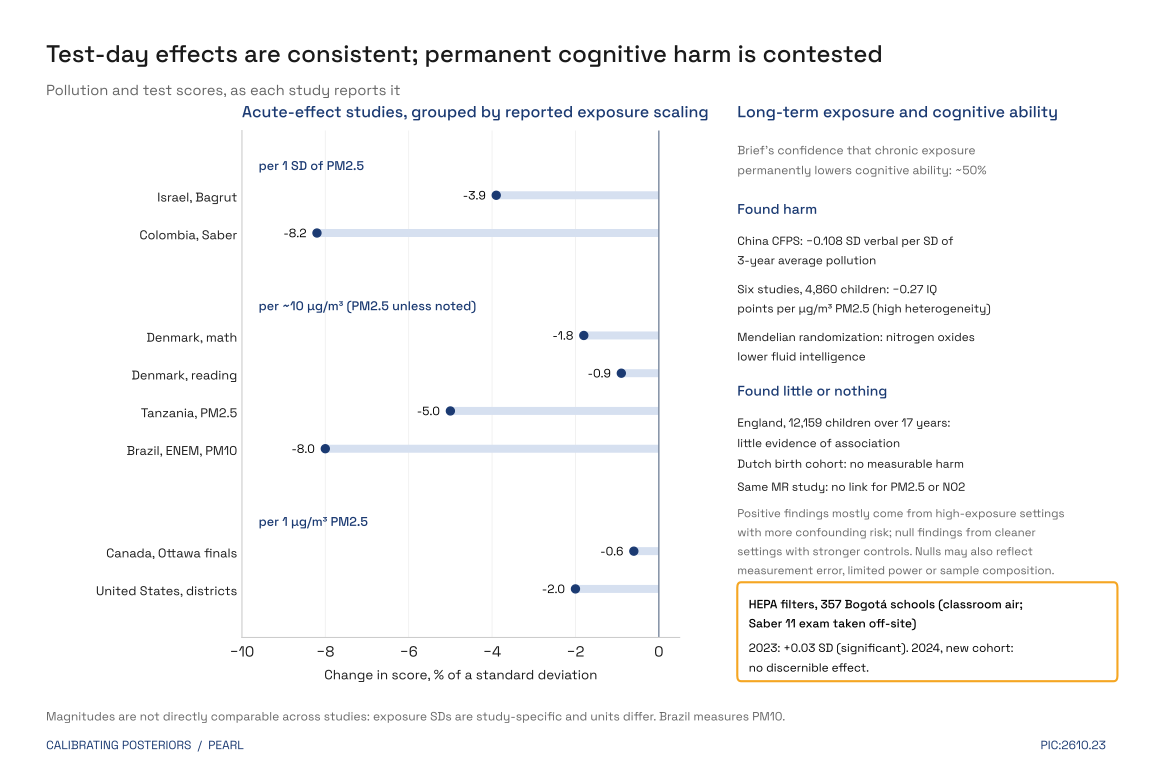
Three regularities survive. First, the effect is causally identified, not merely correlational: the estimates come from within-person variation or credible instruments, and placebo tests using pollution on non-exam days generally return null. Second, the effect is larger where the stakes are highest — single-day, gatekeeping exams. Diversity across multiple exam days lets students recover from one bad session, which is why Ebenstein et al. argue their Bagrut estimates may understate the harm of one-shot exams like the SAT. Third, the effect is regressive. Although the demographic gradient is not identical everywhere, the general pattern is that the already-disadvantaged — low-income, minority, younger, weaker, and in some studies female students — bear the largest performance penalty. Pollution does not just lower the average; it adds noise and bias to the signals that decide who gets ahead.
Beyond the exam hour: the school-year channel
Pollution also acts between tests, through absenteeism and behavior, which matters because these routes operate over the entire school year rather than a single morning.
Chung, Persico & Liu (2025), using daily administrative data for a large California urban district (2003–2020), found that a 10 µg/m³ increase in daily PM2.5 raised full-day student absences by 5.7% over a three-day window and office disciplinary referrals by 28%; teacher absences due to illness rose 13.1%. Effects were driven by low-income, Black, Hispanic, and younger students. Heissel, Persico & Simon (2022) found that Florida students who moved to schools downwind of a highway — and so more polluted — saw test scores fall by about 4% of a standard deviation, behavioral incidents rise, and absences increase relative to otherwise similar moves. Both studies suggest pollution degrades human capital not only by fogging an exam hour but by pulling students and teachers out of classrooms and destabilizing the learning environment.
This channel is important for interpretation: it means the estimated human-capital cost of pollution is unlikely to be limited to the fraction of variance explained by test-day effects. Some of the harm is cumulative and logistical, not merely cognitive-in-the-moment.
The contested claim: does long-term exposure lower cognitive ability?
Here the evidence genuinely conflicts, and the conflict is not just noise — it reflects different populations, exposures, and identification strategies.
Studies finding lasting harm. Zhang, Chen & Zhang (2018, PNAS) matched China's nationally representative CFPS panel to air-quality data at the exact date and location of cognitive tests. Cumulative exposure mattered more than same-day exposure: a one–standard-deviation increase in the three-year average pollution index was associated with a 0.108 standard-deviation drop in verbal scores, with effects growing with age, especially for older, less-educated men. Alter, Whitman, Bellinger & Landrigan (2024) pooled six studies (4,860 children) and found each 1 µg/m³ of PM2.5 associated with a −0.27-point change in full-scale IQ — a small but policy-relevant effect that they note is compounded by very high heterogeneity. Gao et al. (2025), an umbrella review of meta-analyses, graded the PM2.5–ADHD association as "highly suggestive," though it also flagged that 62% of the significant meta-analyses showed small-study effects. Tang et al. (2024) found via MR that nitrogen oxides reduced fluid-intelligence scores.
Studies finding little or nothing. The counterevidence is as strong. Garkov, Dearden, Armstrong & Milojevic (2024), following 12,159 English children for 17 years in the Millennium Cohort Study, found "little evidence of observable associations" between lifetime PM2.5 and cognitive performance at ages 3, 5, 7, 11, 14, or 17 — with or without adjustment for greenness and road noise. Their discussion notes an earlier Dutch birth cohort that likewise found no measurable harm (and some unexplained positive associations), and they list measurement error, limited power, and sample composition as candidate explanations for the null. Tang et al.'s MR study is also a partial null: it found no causal link from PM2.5 or NO2 to cognition, only from nitrogen oxides.
The contradiction is instructive rather than embarrassing. The positive studies tend to rely on large-exposure, high-pollution settings (China, mean PM2.5 around 30 µg/m³ in the IQ meta-analysis) and on cross-person comparisons where poverty and pollution covary; the null studies tend to be cleaner, lower-exposure cohorts with rich socioeconomic controls. That gap itself is the key interpretive fact: where pollution is severe and where it coincides with disadvantage, associations appear; where air is comparatively clean and controls are thorough, they often do not. This is exactly what one would expect if part of the measured "developmental harm" is residual confounding by correlated disadvantage, and part is a real, exposure-dependent effect that fades toward zero as air cleans up.
What would settle it, and what already tested the obvious fix
The decisive experiment would be to clean the air and see whether cognition improves. That experiment has partly been run, and its result is sobering for anyone expecting a large, stable developmental benefit.
Kremer, Romero & Saavedra (2025) randomized portable HEPA filters into 357 Bogotá schools (more than 42,000 students per year), with the high-stakes Saber 11 exam administered off-site so that test-day conditions could not contaminate the estimate. In 2023, treated students scored 0.03 standard deviations higher — a small but statistically significant gain. In 2024, with a fresh cohort, the filters had no discernible effect on test scores. The filters did reduce indoor PM2.5, more so when outdoor air was worse, but the learning benefit was unstable across years. The authors' own cost-benefit framing requires that the 2023 effect recur in at least half of non-pandemic years for filters to pay off — a fragile assumption given the 2024 null.
The honest reading is not that air filters "work" or "don't work," but that the marginal effect of modest indoor-air improvements on learning is small and context-dependent, which is consistent with the acute effect being real but the cumulative school-year effect being harder to move than a simple exposure–response story implies.
Mechanisms
Two families of mechanism are plausible, and they operate on different timescales.
- Acute, transient mechanisms explain the test-day effect: short-term inflammation, mild hypoxia-like effects, neurological irritation, or stress-arousal responses that temporarily degrade attention, working memory, and complex reasoning. The fact that the effect is concentrated on same-day (and a few preceding days') exposure, is largest for reasoning-heavy tasks, is detectable in clean Ottawa, and appears to fade when exposure is removed supports a reversible, performance-state interpretation rather than a structural brain change.
- Cumulative developmental mechanisms would explain lasting harm: chronic neuroinflammation, oxidative stress, or vascular damage during sensitive developmental windows. This is the mechanism the positive developmental studies invoke, and it is biologically plausible — but it is precisely the one the cleaner cohorts and the filter RCT have trouble confirming.
A third, often neglected account is allocative rather than cognitive: even if pollution only shuffles who barely clears a cutoff, high-stakes systems amplify that shuffle into durable differences in schooling and earnings. Ebenstein et al.'s decade-later results are best read this way — the test-score effect is transient, but its consequences are permanent because the institution treats a noisy score as a clean signal of ability.
Evidence quality, caveats, and what would change the picture
- The acute effect is robust; the cumulative effect is not. The acute literature is large, geographically diverse, and identified by within-person or instrumental variation; the cumulative literature is thinner, more heterogeneous, and more exposed to confounding. A confident statement about the first is warranted; a confident statement about the second is not.
- Measurement and ecological fallacy. Exposure is often assigned by monitoring stations, home postcode, or a coarse grid rather than personal dosimetry, which inflates noise and can bias either direction. Garkov et al. explicitly raise measurement error as a possible reason for their null.
- Publication bias and small-study effects. Gao et al. found that most of the significant meta-analyses in this space showed small-study effects, and the PM2.5–IQ meta-analysis had very few studies and high heterogeneity. Effect sizes from meta-analyses here should be treated as suggestive.
- Confounding by correlated disadvantage. Pollution, poverty, race, and school quality are tightly entangled. The wind-direction designs handle this at the local level; cross-cohort designs generally do not.
- Almost all outcomes are test scores. These are proxies. The evidence on adult earnings is strongest for the acute high-stakes channel (via Ebenstein et al.'s instrumented education and wage results) and essentially absent for the cumulative channel, where long-run tracking is still decades away.
- What would update this most: a multi-country RCT or natural experiment with sustained, large air-quality improvements and long-run cognitive outcomes; more pre-registered replications of the Chinese and IQ-meta-analysis findings in low-exposure settings; and longer follow-up of the filter trial to test whether the 2023 gain was a one-off.
What this brief does not claim
It does not claim that air pollution causes intellectual disability or large permanent IQ losses. It does not treat the test-day effect as mostly an artifact of discomfort or effort — the within-person designs and the concentration on reasoning tasks argue against pure motivational explanations. It does not assume that reducing pollution will automatically raise cognitive ability; the filter RCT shows the return can be small and unstable. And it does not translate test-score movements directly into economy-wide productivity losses; those remain modelled extrapolations.
Verdict and calibrated confidence
That short-term air pollution causally and measurably lowers cognitive test performance: ~97%. A dozen independent quasi-experimental studies across four continents, using within-person and instrumental designs, agree on the sign and a broadly consistent magnitude, and placebo tests generally behave.
That the effect is on the order of 0.02–0.08 SD per 10 µg/m³ PM2.5 (or per SD of exposure), larger for mathematics and reasoning: ~90%. The range is wide because of heterogeneous settings and units, but the mathematical/reasoning loading is a recurring feature.
That in high-stakes, single-day systems the test-day effect translates into lasting differences in schooling and earnings: ~80%. Ebenstein, Lavy & Roth's decade-later results are the strongest direct evidence; the mechanism (allocative reliance on noisy scores) is plausible, but it rests substantially on one influential study.
That pollution also harms human capital through absences, discipline, and teacher illness over the school year: ~85%. Two large administrative studies converge, and the mechanisms are credible, though both rely on regional administrative data.
That long-term pollution exposure permanently depresses cognitive ability: ~50%. This is the genuinely open question. Large-exposure studies in China and the PM2.5–IQ meta-analysis find harm; a 17-year English cohort, a Dutch birth cohort, and PM2.5 mendelian randomization find little. The disagreement tracks exposure level and control quality, which is exactly the pattern expected if the effect is real but modest and confounded. I would not state the cumulative claim with confidence in either direction.
What would move me most: sustained, well-measured air-quality improvements in a high-exposure setting followed for a decade of cognitive and earnings outcomes; registered replication of the Chinese CFPS result in a low-exposure cohort with rich controls; and longer-run follow-up of the Bogotá filter trial. On current evidence, the defensible summary is: dirty air reliably dulls the mind for an hour and can change the course of a life through the exams that hour decides, but whether it permanently lowers the mind — and how much — remains unresolved.
References
- Ebenstein A, Lavy V, Roth S. The long-run economic consequences of high-stakes examinations: Evidence from transitory variation in pollution. American Economic Journal: Applied Economics. 2016;8(4):36–65. doi:10.1257/app.20150213.
- Andersen CM, Brandt J, Christensen JH, Frohn LM, Geels C, Hener T, Simonsen M, Skipper L. Air pollution and cognition in children: Evidence from national tests in Denmark. Journal of Human Resources. 2025. doi:10.3368/jhr.1024-13871R1.
- Cook N, Heyes A, Rivers N. Clean air and cognitive productivity: Effect and adaptation. Journal of the Association of Environmental and Resource Economists. 2023;10(5):1265–1308. doi:10.1086/724951.
- Carneiro J, Cole MA, Strobl E. The effects of air pollution on students' cognitive performance: Evidence from Brazilian university entrance tests. Journal of the Association of Environmental and Resource Economists. 2021;8(6). doi:10.1086/714671.
- Villalobos L, Blackman A. Air pollution and education in the Global South: Fine particulates reduce high-stakes test scores in Bogotá. Applied Economics Letters. 2026;33(12):1986–1990. doi:10.1080/13504851.2025.2459883.
- Mtenga EL, Singh TP. Air pollution and student achievement: Evidence from Tanzania. OSF Preprints. 2022. doi:10.31219/osf.io/nm9dx.
- Gilraine M, Zheng A. Air pollution and student performance in the U.S. NBER Working Paper No. 30061. National Bureau of Economic Research; 2022. doi:10.3386/w30061.
- Short-term exposure to air pollution and cognitive performance: New evidence from China's College English Test. Environmental and Resource Economics. 2023;85:211–237. doi:10.1007/s10640-023-00765-7.
- Heissel JA, Persico C, Simon D. Does pollution drive achievement? The effect of traffic pollution on academic performance. Journal of Human Resources. 2022;57(3):747–776. doi:10.3368/jhr.57.3.1218-9903R2.
- Chung S, Persico C, Liu J. The effects of daily air pollution on students and teachers. NBER Working Paper No. 33549. National Bureau of Economic Research; 2025. doi:10.3386/w33549.
- Marcotte DE. Something in the air? Air quality and children's educational outcomes. Economics of Education Review. 2017;56:141–151. doi:10.1016/j.econedurev.2016.12.003.
- Zhang X, Chen X, Zhang X. The impact of exposure to air pollution on cognitive performance. Proceedings of the National Academy of Sciences. 2018;115(37):9193–9197. doi:10.1073/pnas.1809474115.
- Alter NC, Whitman EM, Bellinger DC, Landrigan PJ. Quantifying the association between PM2.5 air pollution and IQ loss in children: A systematic review and meta-analysis. Environmental Health. 2024;23(1):101. doi:10.1186/s12940-024-01122-x.
- Gao X, Zheng X, Wang X, Li Z, Yang L. Environmental pollutant exposure and adverse neurodevelopmental outcomes: An umbrella review and evidence grading of meta-analyses. Journal of Hazardous Materials. 2025;491:137832. doi:10.1016/j.jhazmat.2025.137832.
- Garkov S, Dearden L, Armstrong B, Milojevic A. The relationship between PM2.5, greenness, and road noise exposures and children's cognitive performance in England: The Millennium Cohort Study. Environments. 2024;11(10):213. doi:10.3390/environments11100213.
- Tang Y, Li Z, Fu Y, Zhao M. Causal effects of PM2.5, NOx, and NO2 on cognitive function: A two-sample Mendelian randomization study. Aerosol and Air Quality Research. 2024;24(6):230326. doi:10.4209/aaqr.230326.
- Kremer M, Romero M, Saavedra S. Do air filters improve student learning? Experimental evidence from Colombia. Working paper; 2025. AEARCTR-0009881. https://conference.nber.org/conf_papers/f219319.pdf
- World Health Organization. WHO global air quality guidelines: Particulate matter (PM2.5 and PM10), ozone, nitrogen dioxide, sulfur dioxide and carbon monoxide. Geneva: WHO; 2021. https://www.who.int/news/item/22-09-2021-new-who-global-air-quality-guidelines-aim-to-save-millions-of-lives-from-air-pollution
- World Health Organization. Billions of people still breathe unhealthy air: New WHO data. 4 April 2022. https://www.who.int/news/item/04-04-2022-billions-of-people-still-breathe-unhealthy-air-new-who-data