Public health · Physical activity · Evidence synthesis
How Many Steps a Day Actually Prolongs Life — and How Much of That Number Is Confounding?
Ten thousand steps is a marketing number wearing a lab coat. The largest synthesis of device-measured cohorts puts the inflection at 5,000 to 7,000 steps a day and a 47% lower all-cause mortality versus 2,000 — but every estimate compares walkers to non-walkers, a published correction and two rebuttal letters have landed since, and the threshold moves with the pooling method and with where the sensor was worn.
Abstract
Across dozens of prospective cohorts, adults who take more daily steps die less often, and the dose–response flattens somewhere between 5,000 and 9,000 steps a day. This brief asks whether that plateau is a biological threshold or a saturating confounded curve. The largest synthesis (Ding et al., Lancet Public Health 2025; 31 studies from 24 cohorts) reports, versus 2,000 steps a day, HR 0.53 (0.46–0.60) for all-cause mortality at 7,000 steps, with non-linear inflections around 5,000 to 7,000 for all-cause mortality, CVD incidence, dementia, and falls, and no plateau at all for five other outcomes. GRADE certainty is moderate for most outcomes, upgraded from low on dose–response-gradient criteria. The August 2025 correction to that paper is scoped to one appendix table and leaves the main-text estimates untouched. Two November 2025 letters press reverse causation, residual confounding, and device wear location (70% hip or waist versus 19% wrist; the wrist records about 3,500 more steps a day), and the authors' reply concedes the biases while denying they ever proposed a single number. Randomized trials show +1,656 steps (95% CI 918–2,395) over 12 weeks, and the 30-year Da Qing lifestyle trial shows 1.44 years of life expectancy gained. The brief separates observations, quasi-causal estimates, causal estimates, and extrapolations, and reports calibrated confidence.
Walking more lowers mortality risk steeply below about 7,000 steps a day; the plateau's location is a modelling artifact before it is a biological fact. The best-supported reading is that moving a sedentary adult from 2,000 to 7,000 steps a day is a high-value, well-evidenced change (~92% the association is real, ~80% that raising steps causally reduces mortality), while any specific target number is weakly identified (~35% it is a true threshold) and shifts with pooling method, device wear location, and which cohorts are in the pool.
Precise question and why it matters
Across large prospective cohorts, adults who report or wear more daily steps die less often, and the association flattens somewhere between roughly 5,000 and 9,000 steps per day. Does that plateau mean we have found a real biological threshold — the point at which walking more stops buying survival? Or does it mean the curve is saturating because the people who walk 9,000 steps are, for reasons that have nothing to do with walking, the people who were going to live longer anyway?
The question matters because step counts are the most widely adopted form of physical activity guidance in the world — promoted as simpler and more actionable than the time-and-intensity recommendations in formal guidelines, and most often quoted as if it were a measured dose–response constant. It is not: it moves with age, baseline activity, measurement method, and which studies a meta-analysis happens to pool. Two competent analyses of overlapping literature have put the protective threshold at 3,143 steps and at 7,000 steps. The difference between those two numbers is the entire question.
I use four labels. Observations are measured associations in a single study. Quasi-causal estimates use longitudinal designs, dose–response modelling, or early-death exclusion. Causal estimates come from randomized experiments. Extrapolations extend findings beyond the tested population, duration, or mechanism.
Best current answer
Walking more is almost certainly good for you. The specific number where the benefit stops is not established, and the evidence cannot tell you where your own plateau is. The dose–response is real and steep at the low end, consistently observed across cohorts. The plateau's location is estimated from observational data that cannot fully separate walking from the health of the walker, and its estimated position has moved by more than a factor of two in five years as new cohorts entered the pool.
The practical reading is asymmetric in a useful way. Steps between 2,000 and 7,000 a day carry the large majority of the measurable benefit and sit where the evidence is least confounded: people capable of walking 7,000 steps are less selected on health than people capable of walking 2,000. Above roughly 8,000 to 10,000 steps a day the marginal benefit is small and hard to separate from the fact that the remaining step difference concentrates among people already going to live longer.
What the cohort evidence actually shows
The largest current synthesis is Ding and colleagues' 2025 systematic review and dose–response meta-analysis: 57 studies from 35 cohorts in the review, 31 studies from 24 cohorts in the meta-analyses, all using device-measured steps rather than self-report, with prospective studies published from 2014 through February 2025 (PROSPERO CRD42024529706). Compared with 2,000 steps per day, 7,000 steps per day was associated with:
| Outcome | Estimate vs 2,000 steps/day | Studies | Certainty (GRADE) |
|---|---|---|---|
| All-cause mortality | HR 0.53 (0.46–0.60) | 14 | Moderate |
| CVD incidence | HR 0.75 (0.67–0.85) | 6 | Moderate |
| CVD mortality | HR 0.53 (0.37–0.77) | 3 | Low |
| Cancer incidence | HR 0.94 (0.87–1.01), not significant | 2 | Low |
| Cancer mortality | HR 0.63 (0.55–0.72) | 3 | Moderate |
| Type 2 diabetes incidence | HR 0.86 (0.74–0.99) | 4 | Moderate |
| Dementia | HR 0.62 (0.53–0.73) | 2 | Moderate |
| Depressive symptoms | HR 0.78 (0.73–0.83) | 3 | Moderate |
| Falls | HR 0.72 (0.65–0.81) | 4 | Very low |
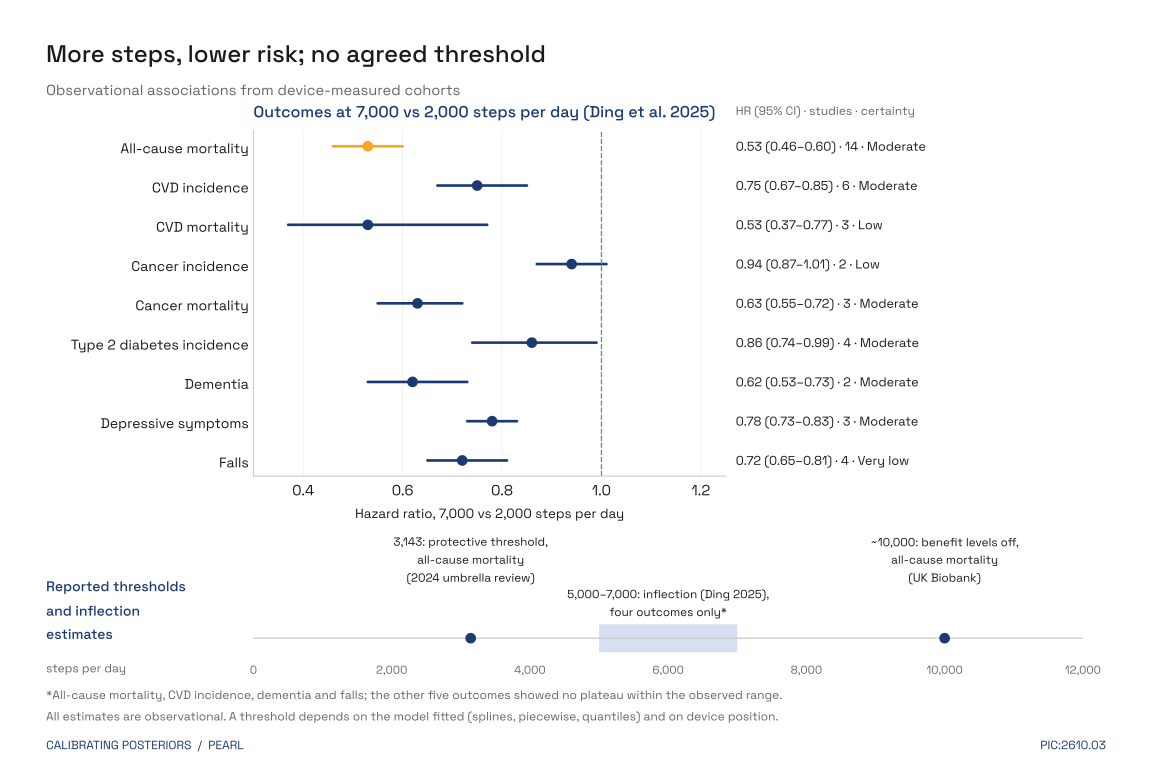
The shape, not just the magnitude, is the interesting part. All-cause mortality, CVD incidence, dementia, and falls showed a non-linear inverse relationship with an inflection point around 5,000 to 7,000 steps per day. CVD mortality, cancer incidence, cancer mortality, diabetes incidence, and depressive symptoms showed a straight-line inverse relationship — no plateau at all within the observed range. One outcome crossed null: cancer incidence (HR 0.94, 0.87–1.01, two studies).
Two things in that table deserve more attention than usual. First, a 47% reduction in all-cause mortality between the bottom and the middle of the distribution is an effect size normally reserved for a strong drug, and it deserves more suspicion, not less. Second, the estimate rests on 14 studies, and the two outcomes with the largest apparent effect on the thinnest evidence — CVD mortality (3 studies, I² = 78%) and dementia (2 studies) — are exactly the ones where small-study and publication-bias corrections would move the numbers most. A published correction to this paper exists (Lancet Public Health 2025;10(9):e731, PMID 40883040). It states only that "in the appendix (p 82), supplementary table 8 has been corrected," as of Aug 27, 2025 — so the main-text Table 2 quoted above is untouched, while the corrected appendix table itself remains unread.
The independent cohort record supports the gradient and the plateau's existence in outline. Paluch and colleagues' meta-analysis of 15 international cohorts (47,471 adults, 3,013 deaths, median 7.1 years' follow-up) found quartile median step counts of 3,553, 5,801, 7,842, and 10,901, with a progressively lower risk of all-cause mortality that continued "up to a level that varied by age" — the same shape, with the same refusal to name a single universal threshold. In a nationally representative US sample (NHANES 2003–2006, 4,840 adults aged 40 and over, 1,165 deaths over a mean 10.1 years), the unadjusted all-cause mortality density fell from 76.7 per 1,000 person-years below 4,000 steps per day through 21.4 and 6.9 to 4.8 per 1,000 person-years at 12,000 steps or more.
The most detailed single cohort is the UK Biobank accelerometry substudy: 78,500 adults aged 40 to 79, median 7 years' follow-up, 2,179 deaths. Each additional 2,000 daily steps was associated with a mean change in the log relative hazard of −0.08 (95% CI −0.11 to −0.06) for all-cause mortality, equivalent to roughly an 8% lower risk, with benefit levelling off around 10,000 steps. A 2026 analysis restricted to 36,192 UK Biobank participants with hypertension gave the per-1,000-step estimate directly: each 1,000 additional steps per day was associated with 17.1% lower risk of major adverse cardiovascular events (95% CI 10.2–23.2), 22.4% lower heart failure risk (11.0–31.7), and 24.5% lower stroke risk (5.3–39.0), up to 10,000 steps per day.
A detail worth pausing on: in the UK Biobank analysis, cadence — how fast the steps were taken — was associated with lower risk across all outcomes beyond the benefit of total step count, and this held in a separate hypertensive cohort too. In the NHANES analysis, by contrast, step intensity was not significantly associated with mortality after adjusting for total steps. Two large studies with strong data disagree about whether how fast you walk matters once you have accounted for how much you walk.
The anomaly: two reviews, two thresholds
A 2024 umbrella review and meta-analysis of daily steps and all-cause mortality (11 systematic reviews, 14 cohort studies, searched to May 2024) concluded that the protective threshold is 3,143 steps per day, with a pooled HR of 0.91 (95% CI 0.87–0.95) per additional 1,000 steps per day, and that the optimal dose varied by age and sex. A separate 2024 umbrella review of 10 systematic reviews concluded that an increase of only 500 to 1,000 steps per day was associated with lower all-cause mortality and cardiovascular events.
The 2025 meta-analysis puts the inflection at 5,000 to 7,000. The same underlying data can be made to produce 3,000, 7,000, or no threshold at all depending on whether you fit restricted cubic splines, piecewise models, quantile categories, or a per-increment linear slope. A threshold is an artifact of the functional form you fit. That does not make the reviews wrong; it makes the threshold a summary statistic of a modelling choice rather than a discovered constant.
This is not a new problem. In 2020, the ROCKET systematic review — 17 prospective studies, over 30,000 adults — reported that "the shape of the dose-response relation is not yet clear" and that "data are currently lacking to identify a specific minimum threshold of daily step counts needed to obtain overall health benefit," while still concluding that each additional 1,000 steps per day was associated with 6–36% lower all-cause mortality and 5–21% lower CVD risk. The direction has been stable for six years. The threshold has not been.
Where the causal case is weakest
Every headline estimate above comes from observational cohorts. The two threats that observational designs in this field cannot fully remove are reverse causation and healthy-user selection.
Reverse causation is specific and quantifiable here. Illness reduces activity before it kills you. A person who walks 4,000 steps a day in year one of a cohort and dies in year three has told you about their disease, not about walking. The standard remedy is to drop early deaths, and Tarp and colleagues tested how far that goes in a US cohort followed for up to 13 years. Their hazard ratios for ascending quartiles of total physical activity against the least active group were 0.74 (0.53–1.04), 0.52 (0.37–0.73), and 0.61 (0.38–1.01). The associations survived more than 10 years of follow-up and exclusion of the first five years, but their conclusion is explicit: excluding deaths within the first two years, which is the common practice, "appeared insufficient to minimise the impact of reverse causation bias." An association that survives dropping five years of deaths is much harder to explain away than one that survives dropping one year — real reassurance, not complete reassurance.
The second threat is harder. Comparing 2,000-step people to 9,000-step people compares populations, not exposures. High step counts co-occur with income, education, occupational activity, and the absence of frailty, chronic pain, obesity, and smoking. Some are adjustable covariates; some unmeasured; some are the same causal pathway seen from the other end — a fitter person has the capacity to walk more, so fitness causes steps while steps correlate with everything fitness predicts. No adjustment separates these, because confounder and mechanism are correlated by construction.
The achievable increment is largest at the bottom of the distribution — fortunate for public health, awkward for causal inference: the curve is steepest where selection effects are weakest and flat where they are strongest.
Two November 2025 letters in the same journal press both threats against the meta-analysis itself. Valet argues that low step counts can proxy undiagnosed morbidity, that a single baseline exposure introduces regression-dilution error, and that reported dose–response curves therefore "should be hypothesis-generating, rather than prescriptive," with quantitative targets coming from randomised or quasi-experimental studies. Prince and colleagues press a measurement objection the authors had extracted but not analysed: 70% of the included studies wore the device on the hip or waist and 19% on the wrist, no wear-location subgroup analysis was run on the inflection points, and wrist devices record roughly 3,500 more steps per day than hip devices — so the 7,000-step target is partly a statement about where the sensor sits. The authors' reply concedes both points — the biases "exist," several analyses were "necessarily descriptive" — but warns against restricting step targets to trials that will never be run, and adds that the work "was never to establish a single magic number." None of this reverses the gradient; all of it widens the uncertainty around any specific number.
The step you can actually take
This is where the randomized evidence lives — and it is more encouraging than the confounding discussion implies, though it measures steps rather than survival.
A 2022 meta-analysis of individual participant data from randomized controlled trials of wearable trackers in adults with cardiometabolic conditions pooled 1,481 participants from 9 of 25 eligible trials. Over a median 12 weeks, steps per day increased by 1,656 (95% CI 918–2,395). Subgroup gains were larger in men, in participants over 50, in White participants, and in those with fewer comorbidities; among delivery formats, only face-to-face delivery significantly increased steps.
Two caveats on that headline. The IPD meta-analysis reached only 47% of eligible participants, so its subgroup patterns may reflect which trials contributed rather than who benefits. And the effect is not universal: in the MyHeart Counts randomized crossover substudy, 1,075 analyzed participants started from a baseline of 2,914 steps per day and the four interventions raised that by only 226 to 319 steps. People who already walk near their ceiling cannot add much — the same selection effect as above, inside a randomized trial.
The translation heuristic from Tudor-Locke and colleagues' 2011 review is useful here. Pedometer interventions in healthy adults typically produce increments "on the order of 2,000–2,500 steps per day" — roughly the distance from the bottom of the distribution to the middle, which is where the observational curve is steepest.
Why the curve flattens
If the plateau is biological rather than statistical, the likely reason is diminishing returns across a set of overlapping pathways rather than a hard switch: each thousand steps adds a little weekly moderate-to-vigorous volume, cuts sedentary time, and nudges insulin sensitivity, blood pressure, endothelial function, sleep, and inflammation. Early gains are large because the baseline is far from optimal; later gains are small because it is closer to it. The "inflection point" at 5,000 to 7,000 steps is what a sum-of-saturating-curve model looks like when plotted — a familiar shape in every physiological dose–response. That makes it plausible, and plausibility is the only thing it is worth.
The cadence findings support a volume-plus-intensity reading rather than a pure step-count reading, but the UK Biobank–NHANES disagreement on whether intensity matters independently keeps this unresolved rather than settled.
Fitness is a different exposure wearing the same clothes
Cardiorespiratory fitness looks like the same phenomenon as step count and behaves quite differently in the data, which is itself evidence that the step-count curve is not measuring one clean thing.
In 122,007 adults referred for exercise treadmill testing at a tertiary care centre, median follow-up 8.4 years and 13,637 deaths, risk-adjusted all-cause mortality was inversely proportional to cardiorespiratory fitness with no observed upper limit of benefit. Elite versus low fitness gave an adjusted HR of 0.20 (0.16–0.24); low versus elite, 5.04 (4.10–6.20). For scale, in the same analysis coronary artery disease gave 1.29 and smoking 1.41 — the step between fitness categories was a larger mortality gradient than either classical risk factor.
In 4,137 self-referred healthy adults followed for a mean 24.2 years after cardiopulmonary exercise testing, low versus high measured fitness gave HR 1.73 (1.20–3.50) for all-cause, 2.27 (1.20–3.49) for cardiovascular, and 2.07 (1.18–3.36) for cancer mortality; each one-met increase in fitness was associated with 11.6%, 16.1%, and 14.0% reductions respectively.
Three contrasts matter. Shape: fitness is graded across its whole range with no plateau in these data, while steps plateau. Measurement: fitness is a laboratory measurement; steps are a behavioural proxy that also loads structural, occupational, and social determinants. Selection: treadmill referrals enrich the cohort for symptoms and disease, inflating the fitness gradient, while the self-referred healthy cohort has the opposite problem. Both are observational; neither resolves the other's bias.
The honest reading is that fitness is probably the more causal exposure, because it is closer to the mechanism and harder to explain by opportunity alone. It is also the more dangerous thing to advise, because it is measured on a treadmill in a clinic.
The one hard-outcome randomized trial
No randomized trial has ever assigned a step count and measured mortality. That is not a gap in the literature; it is a design fact. Mortality needs thousands of events per arm, and any trial large enough to randomize 5,000 versus 9,000 steps per day for fifteen years would cost more than the research budgets it is trying to justify.
The nearest substitute is the Da Qing Diabetes Prevention Outcome Study: a cluster randomized trial that began in 1986 across 33 clinics, assigned 577 adults with impaired glucose tolerance to a control clinic or to one of three six-year interventions (diet, exercise, or diet plus exercise), then followed them for up to 30 years. After 30 years, with 94% of participants assessed for outcomes, the combined intervention groups showed a median 3.96-year delay in diabetes onset (95% CI 1.25–6.67), fewer cardiovascular disease events (HR 0.74, 0.59–0.92), lower microvascular complications (HR 0.65, 0.45–0.95), fewer cardiovascular deaths (HR 0.67, 0.48–0.94), fewer all-cause deaths (HR 0.74, 0.61–0.89), and an average increase in life expectancy of 1.44 years (95% CI 0.20–2.68).
This is the strongest causal evidence in the area, and it is worth being precise about its scope: a supervised six-year lifestyle programme in prediabetic adults in one Chinese city delayed diabetes and reduced all-cause mortality over three decades. It says nothing about a step threshold (no device-based steps were measured), nothing about healthy people, and nothing about walking alone (diet was bundled in). And the survival benefit took decades to appear — the opposite of how step-count findings are usually reported.
One further post-hoc signal, offered as counterevidence rather than support: in the Look AHEAD randomized trial (adults with type 2 diabetes and overweight or obesity), an increase in accelerometer-measured moderate-to-vigorous activity from baseline to year 1 was not associated with later cardiovascular disease, while the increase to year 4 was (HR 0.97, 95% CI 0.95–0.99, per 100 MET-min/week). Whether early behaviour change predicts nothing and late change everything, or whether this is a post-hoc power problem, is unresolved.
What the arithmetic implies, and why it overstates
It is tempting to chain the two halves of this evidence: randomized trials show that people can add about 1,656 steps per day, and cohorts show that each 1,000 steps is associated with 9–17% lower mortality risk, so chaining them suggests 15–28%.
Do not do this. The two numbers come from different populations, baselines, countries, and definitions, and the per-step slope is estimated largely from between-person comparisons. Multiplying a randomized between-arm effect on the exposure by an observational between-person slope on the outcome overstates the result — like concluding that a diploma would raise everyone's income by the education wage premium.
What survives the criticism is narrower and still worth having. Randomized interventions reliably move daily steps by 1,600 to 2,500 in adults who are not already near their ceiling. The observational dose–response over the 2,000-to-7,000 range is steep and consistent across four continents, survives exclusion of the first five years of follow-up, and is graded rather than binary. Those two facts together make it reasonable to believe that moving a sedentary adult from 2,000 to 7,000 steps per day is one of the better-evidenced interventions available without a prescription. They do not license a precise number for the mortality reduction, nor anything useful about the difference between 7,000 and 10,000.
Evidence quality and limitations
Strengths. The largest synthesis restricts inclusion to device-measured steps, registered prospectively (PROSPERO CRD42024529706), rates certainty with GRADE explicitly, and reports a published correction. Those "moderate" ratings start from low — the observational default — and were earned by upgrading on dose–response gradient criteria, which rewards the very shape under debate here. The step-count gradient has been reproduced in US, UK, Chinese, Australian, and Nordic cohorts using different devices and different designs. The randomized evidence on achievable step increments is individual-participant-data pooled rather than extracted from published summaries.
Weaknesses. Every mortality estimate is observational. The number of studies per outcome is small: 14 for all-cause mortality, 6 for CVD incidence, 3 for CVD mortality, 2 for dementia, 2 for cancer incidence. Several outcomes show high heterogeneity (I² = 78% for CVD mortality, 74% for cancer incidence), which means each pooled estimate is an average across genuinely different relationships. Ding and colleagues themselves flag a lack of age-specific analysis, individual-study bias, and residual confounding. The UK Biobank accelerometry cohort is 97% White and drawn from a volunteer subset of a national cohort.
A specific disclosure. The correction notice for the load-bearing 2025 meta-analysis was retrieved on 6 October 2026: it corrects supplementary table 8 of the appendix (p 82), as of Aug 27, 2025, and does not touch the main-text estimates quoted here. The corrected table itself is still unread, so if any main-text conclusion was derived from it, this brief needs revision. The November 2025 correspondence disputes the interpretation rather than the arithmetic, and leaves open that 7,000 steps is partly a hip-wear figure.
What I did not do. No systematic search protocol was run: the base came from targeted PubMed and Europe PMC queries, so a relevant study could have been missed. No de novo analysis was performed.
Calibrated confidence
- ~92% that the association between daily step count and lower all-cause and cardiovascular mortality in adults is real and not entirely explained by confounding. Basis: consistent direction across dozens of cohorts on four continents; graded rather than threshold-like associations; persistence after five-year early-death exclusion; GRADE-moderate certainty for the primary outcomes.
- ~80% that increasing daily steps in a sedentary adult causally reduces mortality risk. Basis: the Da Qing hard-outcome randomized evidence plus the RCT-confirmed achievability of the exposure. Held below 90% because no trial has randomized step count and measured survival, and because Da Qing bundled diet with exercise in a prediabetic Chinese population.
- ~35% that any specific number between 3,000 and 10,000 steps per day is a real biological threshold rather than an artifact of exposure measurement and pooling method. Basis: published thresholds spanning 3,143 to 7,000 for overlapping literature; the 2020 review explicitly saying the shape is unclear and the threshold unidentified; nonlinear, sum-of-saturating-curve shapes being ubiquitous.
- ~70% that step count understates the benefit of purposeful, faster walking, because cadence findings in UK Biobank add information beyond total steps — tempered by the NHANES null.
- ~55% that the mortality gradient for cardiorespiratory fitness is more causal than the one for step count. Basis: fitness is closer to mechanism, is measured under controlled conditions, and shows no plateau — against the reality that both fitness datasets are referral-selected.
Reversal conditions
This brief should be revised or withdrawn if any of the following occurs:
- The corrected appendix supplementary table 8 of Ding et al. 2025 is obtained and its contents feed back into the main-text estimates or the study-exclusion logic. (Resolved 6 Oct 2026 at the notice level: the correction is scoped to appendix p 82, and the main-text HRs are untouched. What remains unread is the table.)
- A randomized controlled trial assigns a device-measured step target and reports a hard endpoint such as cardiovascular events or mortality. This would move the causal confidence above 90% or refute it outright; nothing short of this will.
- An individual-participant-data meta-analysis with high step-count exposure ascertainment reports a substantially different threshold. The 2022 wearable IPD meta-analysis is the closest existing model, but it did not measure mortality.
- Mendelian randomization or another instrumental-variable design using a genetic proxy for habitual activity reports no association with cardiovascular mortality, or a much smaller one than the cohorts suggest.
- A large cohort with high-quality step measurement and near-complete confounder data reports that the gradient between 7,000 and 10,000 steps per day is indistinguishable from zero after adjusting for socioeconomic position, occupational activity, and comorbidity, while the gradient below 5,000 persists.
- The 2026 and 2027 literature brings a dose–response meta-analysis that supersedes Ding et al. 2025 with comparable GRADE ratings and different pooling; the direction of travel between 2020 and 2025 makes this a live possibility rather than a remote one.
- Step intensity is shown to be independent of total steps in a third large cohort with harmonized cadence measurement, resolving the UK Biobank–NHANES disagreement in one direction.
- A wear-location-stratified reanalysis of the dose–response literature shows the inflection point differing materially between wrist- and hip-worn studies, which would relocate the 7,000-step target rather than merely widening its interval.
References
- Ding D, Nguyen B, Nau T, Luo M, Del Pozo Cruz B, Dempsey PC, Munn Z, Jefferis BJ, Sherrington C, Calleja EA, Hau Chong K, Davis R, Francois ME, Tiedemann A, Biddle SJH, Okely A, Bauman A, Ekelund U, Clare P, Owen K. Daily steps and health outcomes in adults: a systematic review and dose-response meta-analysis. Lancet Public Health. 2025;10(8):e668–e681. doi:10.1016/S2468-2667(25)00164-1. PMID 40713949. (Correction: Lancet Public Health. 2025;10(9):e731. doi:10.1016/S2468-2667(25)00199-9. PMID 40883040.)
- Paluch AE, Bajpai S, Bassett DR Jr, Carnethon MR, Ekelund U, Evenson KR, et al.; Steps for Health Collaborative. Daily steps and all-cause mortality: a meta-analysis of 15 international cohorts. Lancet Public Health. 2022;7(3):e219–e228. doi:10.1016/S2468-2667(21)00302-9. PMID 35247352.
- Del Pozo Cruz B, Ahmadi MN, Lee IM, Stamatakis E. Prospective associations of daily step counts and intensity with cancer and cardiovascular disease incidence and mortality and all-cause mortality. JAMA Internal Medicine. 2022;182(11):1139–1148. doi:10.1001/jamainternmed.2022.4000. PMID 36094529.
- Cheng SWM, Biswas RK, Koemel NA, O'Sullivan JF, Sabag A, Ahmadi MN, Stamatakis E. Prospective associations of daily step count and stepping intensity with overall and type-specific major adverse cardiovascular events in people with hypertension. European Journal of Preventive Cardiology. 2026;33(12):2217–2224. doi:10.1093/eurjpc/zwaf441. PMID 40795029.
- Saint-Maurice PFJ, Troiano RP, Bassett DR Jr, Graubard BI, Desiderio V, Tabak AG. Association of daily step count and step intensity with mortality among US adults. JAMA. 2020;323(12):1151–1160. doi:10.1001/jama.2020.1382. PMID 32207799.
- Tarp J, Hansen BH, Fagerland MW, Steene-Johannessen J, Harter AK, Pietiläinen KH, et al. Accelerometer-measured physical activity and sedentary time in a cohort of US adults followed for up to 13 years: the influence of removing early follow-up. International Journal of Behavioral Nutrition and Physical Activity. 2020;17:39. doi:10.1186/s12966-020-00945-4. PMID 32169059.
- Hall KS, Hyde ET, Bassett DR Jr, et al. Systematic review of the prospective association of daily step counts with risk of mortality, cardiovascular disease, and dysglycemia. International Journal of Behavioral Nutrition and Physical Activity. 2020;17(1):78. doi:10.1186/s12966-020-00978-9. PMID 32563261.
- Rodríguez-Gutiérrez E, Torres-Costoso A, Del Pozo Cruz B, de Arenas-Arroyo SN, Pascual-Morena C, Bizzozero-Peroni B, Martínez-Vizcaíno V. Daily steps and all-cause mortality: an umbrella review and meta-analysis. Preventive Medicine. 2024;185:108047. doi:10.1016/j.ypmed.2024.108047. PMID 38901742.
- Xu C, Jia J, Zhao B, Yuan M, Luo N, Zhang F, Wang H. Objectively measured daily steps and health outcomes: an umbrella review of the systematic review and meta-analysis of observational studies. BMJ Open. 2024;14(10):e088524. doi:10.1136/bmjopen-2024-088524. PMID 39384238.
- Hodkinson A, Kontopantelis E, Zghebi SS, Grigoroglou C, McMillan B, Marwijk HV, et al. Association between patient factors and the effectiveness of wearable trackers at increasing the number of steps per day among adults with cardiometabolic conditions: meta-analysis of individual patient data from randomized controlled trials. Journal of Medical Internet Research. 2022;24(8):e36337. doi:10.2196/36337. PMID 36040779.
- Shcherbina A, Hershman SG, Lazzeroni L, et al. The effect of digital physical activity interventions on daily step count: a randomised controlled crossover substudy of the MyHeart Counts Cardiometabolic Study. Lancet Digital Health. 2019;1(7):e344–e352. doi:10.1016/S2589-7500(19)30129-3. PMID 33323209.
- Tudor-Locke C, Craig CL, Brown WJ, Clemes SA, De Cocker K, Giles-Corti B, et al. How many steps/day are enough? For adults. International Journal of Behavioral Nutrition and Physical Activity. 2011;8:79. doi:10.1186/1479-5868-8-79. PMID 21798015.
- Mandsager K, Harb S, Cremer P, Phelan D, Nissen SE, Jaber W. Association of cardiorespiratory fitness with long-term mortality among adults undergoing exercise treadmill testing. JAMA Network Open. 2018;1(6):e183605. doi:10.1001/jamanetworkopen.2018.3605. PMID 30646252.
- Imboden MT, Harber MP, Whaley MH, Finch WH, Bishop DL, Kaminsky LA. Cardiorespiratory fitness and mortality in healthy men and women. Journal of the American College of Cardiology. 2018;72(19):2283–2292. doi:10.1016/j.jacc.2018.08.2166. PMID 30384883.
- Gong Q, Zhang P, Wang J, Ma J, An Y, Chen Y, et al.; Da Qing Diabetes Prevention Study Group. Morbidity and mortality after lifestyle intervention for people with impaired glucose tolerance: 30-year results of the Da Qing Diabetes Prevention Outcome Study. Lancet Diabetes & Endocrinology. 2019;7(6):452–461. doi:10.1016/S2213-8587(19)30093-2. PMID 31036503.
- Look AHEAD Study Group. Association between change in accelerometer-measured and self-reported physical activity and cardiovascular disease in the Look AHEAD Trial. Diabetes Care. 2022;45(3):742–749. doi:10.2337/dc21-1206. PMID 35019976.
- Valet M. Reflections on daily steps and health outcomes. Lancet Public Health. 2025;10(11):e900. doi:10.1016/S2468-2667(25)00246-4. PMID 41162123.
- Prince SA, Roberts KC, Betancourt MT, Colley RC. Reflections on daily steps and health outcomes. Lancet Public Health. 2025;10(11):e901. doi:10.1016/S2468-2667(25)00247-6. PMID 41162124.
- Ding D, Owen K, Nguyen B, Luo M, Clare P. Reflections on daily steps and health outcomes – Authors' reply. Lancet Public Health. 2025;10(11):e902. doi:10.1016/S2468-2667(25)00248-8. PMID 41162125.