Public health · Environmental economics · Evidence synthesis
Did Leaded Gasoline Help Drive the Twentieth Century's Crime Wave? What the Best Designs Actually Show
The lead–crime hypothesis is one of the most elegant stories in social science: poison children with lead from car exhaust, and two decades later they commit more violent crime; remove the lead, and crime falls. The best-identified studies do find that lead exposure increases later offending. The strongest version of the story — that lead explains most of the great crime decline of the 1990s — does not survive the bias-corrected evidence. Both findings can be true at once, and the gap between them is where the policy lives.
Abstract
This brief asks what the best-identified evidence supports about the lead–crime hypothesis: does childhood lead exposure cause criminal behavior in adulthood, and how much of the twentieth century's rise and fall in violent crime can lead abatement explain? Individual-level prospective cohorts, quasi-experiments exploiting the phase-out of leaded gasoline and the historical placement of lead water pipes, and administrative-registry studies all converge on a real, dose-responsive causal effect of early lead exposure on later antisocial outcomes and criminal arrests. The population-level attribution question is different: the first meta-analysis of the field, pooling 542 estimates from 24 studies, finds substantial publication bias, a corrected mean effect far smaller than headline claims, and lead abatement responsible for a minority — roughly 7 to 28 percent — of the fall in United States homicide. Lead is a genuine, policy-relevant causal lever on violence, not the master explanation of the 1990s crime decline.
Childhood lead exposure causally impairs cognition and self-control and raises the risk of adult offending — the causal claim is well supported by converging individual and quasi-experimental designs. But the popular attribution of most of the 1990s United States crime decline to gasoline lead abatement is not supported once publication bias is corrected: the best synthesis credits lead abatement with a real but minority share of the decline. Lead policy is justified on health and equity grounds; it should not carry the entire historical burden of crime explanation.
The question
Between roughly 1960 and 1990, gasoline sold in the United States contained varying amounts of tetraethyllead, and the lead that came out of tailpipes settled into the dust and soil beside roads, where young children encountered it. Childhood blood lead levels rose and then fell as regulations tightened. About twenty years later, violent crime rose and then fell. In 2000, the environmental psychologist Rick Nevin laid the two curves over each other and noted that they matched, with a lag [2]. Jessica Reyes then exploited the fact that different United States states removed gasoline lead at different speeds under the Clean Air Act and estimated a causal effect of childhood lead exposure on state violent crime rates two decades later [1]. The lead–crime hypothesis was born: childhood lead poisoning is a major, hidden driver of adult violence, and its removal is a major, hidden reason crime fell.
This brief separates two claims that are routinely welded together in popular retellings:
- The individual causal claim: does exposure to lead in childhood make a person more likely to commit crimes as an adult?
- The population attribution claim: how much of the twentieth century's rise and fall in violent crime — in particular, the steep United States decline that began around 1992 — is explained by changes in population lead exposure?
The two claims need different evidence, and they have different answers.
Why it matters
The attribution claim is not an antique curiosity. It is invoked whenever a government resists lead abatement ("crime fell for other reasons"), whenever a commentator wants a structural explanation for the 1990s crime drop that does not involve policing or prisons, and whenever public-health advocates monetize the benefits of pollution control. The United Nations Environment Programme's 2021 announcement that leaded petrol had finally ended worldwide — the last country, Algeria, switched in July — cited both the mortality benefits and the crime-reduction narrative in its framing [15]. Getting the magnitude right changes what societies think pollution control is worth, and it changes whether residual lead exposure — from paint, soil, and drinking-water pipes, which remains widespread — is treated as a crime-prevention investment or only a health investment.
There is also a methodological stake. The lead–crime literature is a favorite example of how a plausible, elegant, ecologically suggestive story can accumulate positive findings before anyone checks for the accumulated publication bias. The first meta-analysis of the field [6] is as much a case study in evidence hygiene as a substantive result.
What each design actually identifies
The literature mixes designs that answer different questions. Separating them does most of the analytical work.
Ecological time series (observation, not identification). Nevin's original and extended work correlates lead emissions — from gasoline nationally, and from petrol across countries — with IQ trends, violent crime, and unwed pregnancy at a twenty-to-thirty-year lag [2,3]. The correlations are striking. But two national time series can move together because of anything else that changed with a generational lag, and the unit of analysis is the country or decade, not the person. This is hypothesis-generating evidence, and it should be read as such.
Individual prospective cohorts (causal leverage from timing, limited generalizability). The Cincinnati lead study followed children with measured blood lead levels from birth into adulthood. Wright and colleagues reported that higher prenatal and childhood blood lead concentrations predicted criminal arrests in early adulthood, with the association strongest among boys with low birth weight [9]. Cecil and colleagues imaged the same cohort's brains decades later and found reduced gray-matter volume in adults who had higher childhood blood lead [10]. These studies fix the temporal order — exposure precedes offending — and measure the exposure in the person, but the cohort is small, urban, and disproportionately poor, so magnitudes do not transport cleanly.
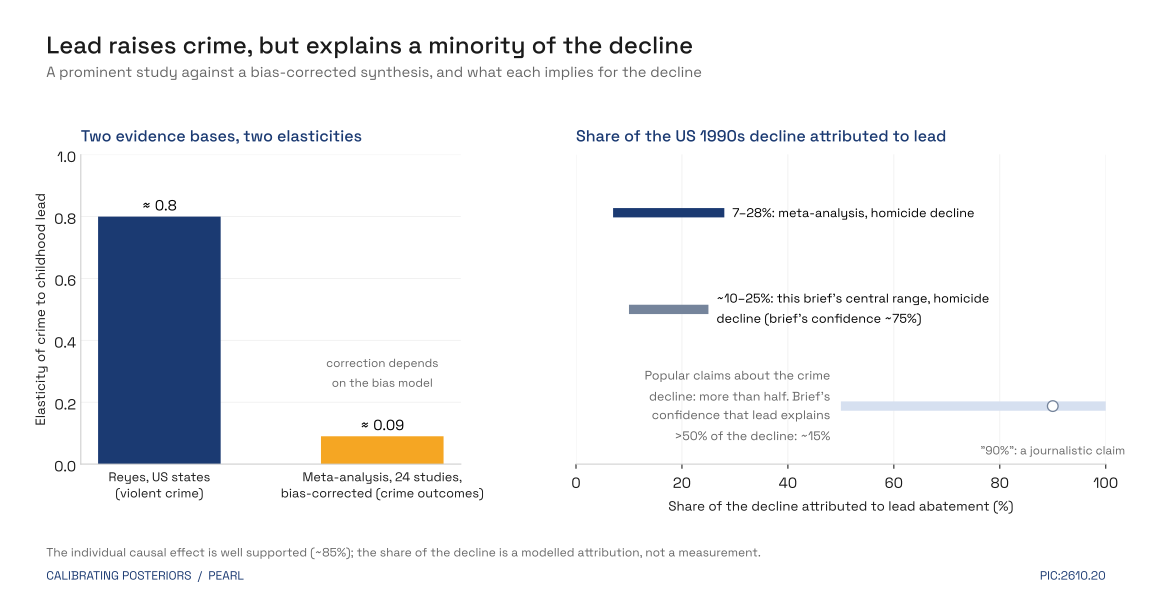
Quasi-experiments on gasoline lead (the core causal evidence). Reyes compared United States states whose lead exposure fell faster and slower as the Clean Air Act bit, and estimated an elasticity of violent crime with respect to childhood lead exposure of about 0.8 — a 10 percent fall in lead exposure associated with roughly an 8 percent fall in violent crime two decades later [1]. She found mixed evidence for murder, little for property crime, and concluded that the decline in childhood lead exposure "was responsible for significant declines in violent crime in the 1990s." Grönqvist, Nilsson, and Robling brought the same idea to Swedish administrative records covering roughly 800,000 children exposed to different degrees to the phase-out of leaded gasoline [5]. Reduced exposure improved schooling, high-school completion, earnings, and criminal outcomes in adulthood, most strongly for boys; non-cognitive skills — externalizing behavior, conscientiousness — mediated a sizeable share of the effect on crime; and the dose-response was nonlinear, with the steepest damage at exposure levels that were still, at the time of the study, relevant to contemporary populations. Because outcomes come from population registries rather than small cohorts, this is currently the strongest single bridge between individual exposure and adult offending.
A different quasi-experiment: nineteenth-century water pipes. Feigenbaum and Muller exploited a source of lead exposure that predates gasoline: cities that installed lead water pipes in the late nineteenth century, and the fact that lead only leaches substantially into soft, acidic water [4]. Comparing cities with lead pipes and acidic water to otherwise similar cities with pipes but hard water, or acidic water but no lead pipes, they estimated that lead-pipe cities experienced homicide rates roughly a quarter higher two decades later, when the exposed cohort reached young adulthood. Their design sidesteps gasoline-era confounds entirely — different cities, different century, different data — and still finds a positive, policy-relevant effect. It remains a city-level design: it identifies an effect of municipal exposure on municipal homicide, not a per-person dose-response.
The bias check: a meta-analysis. Higney, Hanley, and Moro pooled 542 estimates from 24 studies of lead and crime [6]. They found clear evidence of publication bias — studies with positive, larger effects are overrepresented — and after correcting for it, the mean effect size shrank to a partial correlation of about 0.16 and an elasticity of roughly 0.09, an order of magnitude below Reyes's headline figure. Their honest summary: lead abatement may be responsible for 7 to 28 percent of the fall in United States homicide, and 6 to 20 percent of the convergence between urban and rural crime rates. "Lead increases crime," they conclude, "but does not explain the majority of the fall in crime observed in some countries in the 20th century."
The best current answer
On the individual causal claim, the evidence is strong and convergent. Prospective cohorts with measured blood lead [9], imaging of the same cohort's brains [10], the Swedish registry-scale phase-out study [5], and the water-pipe quasi-experiment [4] all point the same way, and the meta-analysis finds a positive mean effect even after correcting for bias [6]. The dose- response evidence in children — including the finding that intellectual impairment is detectable at blood lead concentrations below 10 micrograms per deciliter [11], a threshold far above what today's guidelines treat as safe — makes a threshold-free biological mechanism plausible. The World Health Organization's position that no safe level of childhood lead exposure has been identified is consistent with this literature [16]. Confidence that early lead exposure causally worsens later antisocial outcomes and criminal arrests at the individual level: ~85 percent.
On the population attribution claim, the honest answer is a minority share. Reyes's state-level elasticity of 0.8 [1] and Nevin's near-perfect curve matches [2,3] are the sources of the popular claim that lead explains more than half — sometimes "90 percent" in journalism — of the crime decline. The meta-analytic correction [6] says the true average effect is much smaller, and that even generous accounting puts lead abatement at 7 to 28 percent of the United States homicide decline. Confidence that lead abatement explains a minority share — call it roughly 10 to 25 percent at the center of the plausible range — of that decline: ~75 percent. Confidence that it explains most of the decline, as the strongest popular versions claim: ~15 percent.
Crucially, these are not contradictory. A causal effect of lead on crime can be real, policy-relevant, and worth billions in avoided harm, while still being one input among several in a national crime trend that was also shaped by the crack epidemic's rise and bust, policing and incarceration policy, demographic change, economic conditions, and — on one contested but serious account — legalized abortion [12,13]. Levitt's widely read 2004 assessment of the 1990s decline attributed most of it to four factors — incarceration, policing, the crack decline, and abortion — and treated lead as unproven at the national level [12]. The subsequent quasi-experimental work [4,5] has strengthened the case that Levitt was too dismissive of lead as a causal lever; it has not obviously vindicated the stronger claim that lead was the dominant driver of the trend.
Mechanism: how lead could reach lawbreaking
The proposed causal chain has links with different evidential strength.
- Lead damages the developing brain. This is the best-established link. Population and cohort evidence links early lead exposure to reduced IQ [11], altered brain structure [10], attention and conduct problems, and — in the Swedish registry study — measurable changes in non-cognitive traits: externalizing behavior, impulsivity, and conscientiouness [5]. Lead's neurotoxicity operates at the cellular level (NMDA-receptor and dopamine-system disruption in the prefrontal cortex and hippocampus), which gives the behavioral findings a biological substrate rather than a purely statistical one.
- Those traits raise offending risk. Impulse control, attention, and conduct problems in childhood are among the more robust individual-level predictors of adolescent and adult offending; this is mainstream developmental criminology, independent of the lead debate.
- The exposure-to-crime elasticity at population scale is the soft link. Translating a one-person neurotoxic effect into a city- or nation-level crime elasticity involves assumptions about exposure distributions, substitution toward other risks, and the counterfactual crime trend. The Swedish study's finding that non-cognitive mediation accounts for a sizeable but not complete share of the crime effect [5] is a reminder that the mechanism is real but not the whole story.
A note on specificity: in the quasi-experimental studies, the effects concentrate in violent offending rather than property crime [1,6], which is consistent with an impulsivity-and-aggression pathway rather than a general "less lawful behavior" pathway. The meta-analysis could not, however, confidently distinguish homicide from other violent or even non-violent categories [6], so the specificity claim is suggestive rather than settled.
Counterevidence and unresolved weaknesses
The skeptical case has real substance and should not be waved away.
The criminological data themselves are contested. Lauritsen, Rezey, and Heimer re-examined United States crime trends from 1973 to 2012 and found that lagged gasoline lead consumption is only weakly correlated with national trends in homicide and serious violence measured by the National Crime Victimization Survey, and that conclusions in this literature are sensitive to which crime series is used [7]. If the outcome variable moves depending on whether you use police-reported or survey-reported crime, ecological attributions built on one series are fragile.
Ecological designs remain ecological. Even the strongest papers operate at the state [1] or city [4] level for the crime outcome. Unobserved co-moving factors — migration, other pollutants, economic restructuring — can mimic a lagged lead effect. Feigenbaum and Muller's design is clever precisely because it addresses the most obvious confound (cities that chose lead pipes were richer), and it is still not a randomized trial.
The publication-bias correction is itself a model. Higney and colleagues' estimate of the corrected mean effect depends on how bias is modeled; their one-million-specification robustness exercise [6] is reassuring but cannot rule out that the true effect sits in Reyes's range [1]. Verbruggen's non-peer-reviewed review reaches a similar verdict — lead probably matters, the majority-share claims are overstated — and emphasizes that abatement policy does not depend on the crime story being maximally large [17]. William Hall's earlier narrative assessment [8] reached a cautious, pre-meta-analytic verdict: the evidence was not sufficient to conclude that environmental lead explains the rise and fall of United States crime.
Magnitudes in time. The Swedish and American quasi-experiments identify effects at exposure levels far above today's high-income-country averages. The Swedish authors' own nonlinear dose-response [5] suggests effects persist at lower levels, but extrapolating the crime elasticity to contemporary exposure distributions is a modeling choice, not a measurement.
What the evidence cannot yet tell us
Two gaps matter most.
Late-phasing countries' cohort effects are mostly untested. Leaded petrol did not end worldwide until July 2021, and 86 countries were still using it when the United Nations campaign began in 2002 [15]. The core quasi- experiments come from the United States and Sweden, countries that cleaned up early. Whether the twenty-year-lagged crime consequences of leaded petrol are now materializing in later-phasing countries is an open, testable question, not an established fact; treating it as established is exactly the kind of extrapolation this literature's history warns against. A recent Scottish natural experiment on lead in drinking water and infant outcomes [14] shows the design family extending to new exposures and outcomes, but the crime endpoint at scale in late-phasing countries remains missing.
Residual exposure is still large and still unevaluated as crime policy. Even in early-phasing countries, lead persists in paint, soil, and service lines; United States estimates published in 2024 suggest a large minority of residential soils exceed contemporary screening levels. The crime-relevant benefit of remediating that legacy exposure, at today's lower average doses, has not been estimated with the gasoline-phase-out designs' credibility.
A third, quieter gap: the direct-versus-indirect decomposition. Incapacitation and deterrence debates in criminal justice routinely separate mechanisms that need different identification strategies; the lead literature rarely does the equivalent, distinguishing lead's effect on the propensity to offend from its effect on the detection of offending (via schooling, employment, and police contact patterns). The Swedish earnings and schooling outcomes [5] suggest both channels are active, and no study cleanly separates them.
Calibration, reversal conditions, and the practical verdict
Summary of calibrated positions, stated as what would change them:
- ~95 percent: childhood lead exposure causes lasting neurodevelopmental harm, including at doses far below the historical poisoning threshold. Reversal would require the large low-dose literature [11] to be overturned by unconfounded nulls, which is implausible given convergent toxicology.
- ~85 percent: higher early lead exposure causally increases later antisocial behavior and criminal arrests at the individual level. Reversal would require a registry-scale study with exogenous exposure variation — the Grönqvist design with better instruments — returning tight nulls.
- ~75 percent: gasoline-lead abatement explains a minority share (roughly 10 to 25 percent) of the United States 1990s homicide decline, the outcome the meta-analytic attribution covers. Reversal upward would require new quasi-experiments whose estimates cluster near Reyes's elasticity [1] and whose identification survives the outcome-series sensitivity documented by Lauritsen and colleagues [7]; reversal downward would require the corrected meta-analytic mean [6] to shrink further as the field's bias becomes clearer.
- ~15 percent: lead explains most of the decline, as the strongest popular accounts claim. I would update only on a convergent new generation of designs, not on another correlation of two curves.
The practical verdict survives the calibration. Even the minority-share estimate implies that lead abatement bought a large amount of avoided violence, at a fraction of its monetized value in Reyes's own accounting [1], and independent of crime, the health and cognitive returns to lead removal are enormous [15,16]. The correct update from the meta-analysis is not "lead policy was a mistake"; it is "lead policy was a real, high-return health and equity intervention whose crime dividend was real but smaller than its most famous story claimed — and other explanations for the crime decline deserve correspondingly more of the explanatory budget."
References
- Reyes JW. Environmental Policy as Social Policy? The Impact of Childhood Lead Exposure on Crime. The B.E. Journal of Economic Analysis & Policy. 2007;7(1). doi:10.2202/1935-1682.1796
- Nevin R. How lead exposure relates to temporal changes in IQ, violent crime, and unwed pregnancy. Environmental Research. 2000;83(1):1-22. doi:10.1006/enrs.1999.4045
- Nevin R. Understanding international crime trends: The legacy of preschool lead exposure. Environmental Research. 2007;104(3):315-336. doi:10.1016/j.envres.2007.02.008
- Feigenbaum JJ, Muller CP. Lead exposure and violent crime in the early twentieth century. Explorations in Economic History. 2016;62:51-86. doi:10.1016/j.eeh.2016.03.002
- Grönqvist H, Nilsson JP, Robling P-O. Understanding How Low Levels of Early Lead Exposure Affect Children's Life Trajectories. Journal of Political Economy. 2020;128(9):3376-3433. doi:10.1086/708725
- Higney A, Hanley N, Moro M. The lead-crime hypothesis: A meta-analysis. Regional Science and Urban Economics. 2022;97:103826. doi:10.1016/j.regsciurbeco.2022.103826
- Lauritsen JL, Rezey ML, Heimer K. When Choice of Data Matters: Analyses of U.S. Crime Trends, 1973-2012. Journal of Quantitative Criminology. 2016;32(3):335-355. doi:10.1007/s10940-015-9277-2
- Hall W. Did the elimination of lead from petrol reduce crime in the USA in the 1990s? F1000Research. 2013;2:156. doi:10.12688/f1000research.2-156.v2
- Wright JP, Dietrich KN, Ris MD, et al. Association of Prenatal and Childhood Blood Lead Concentrations with Criminal Arrests in Early Adulthood. PLoS Medicine. 2008;5(5):e101. doi:10.1371/journal.pmed.0050101
- Cecil KM, Brubaker CJ, Adler CM, et al. Decreased Brain Volume in Adults with Childhood Lead Exposure. PLoS Medicine. 2008;5(5):e112. doi:10.1371/journal.pmed.0050112
- Canfield RL, Henderson CR, Cory-Slechta DA, Cox C, Jusko TA, Lanphear BP. Intellectual Impairment in Children with Blood Lead Concentrations below 10 μg per Deciliter. New England Journal of Medicine. 2003;348(16):1517-1526. doi:10.1056/NEJMoa022848
- Levitt SD. Understanding Why Crime Fell in the 1990s: Four Factors that Explain the Decline and Six that Do Not. Journal of Economic Perspectives. 2004;18(2):163-190. doi:10.1257/089533004773563485
- Donohue JJ, Levitt SD. The Impact of Legalized Abortion on Crime. The Quarterly Journal of Economics. 2001;116(2):379-420. doi:10.1162/00335530151144050
- Higney A, Hanley N, Moro M. The Impact of Lead Water Pollution on Birth Outcomes: A Natural Experiment in Scotland. Environmental and Resource Economics. 2025. doi:10.1007/s10640-025-01041-6
- United Nations Environment Programme. Era of leaded petrol over, eliminating a major threat to human and planetary health. Press release, 30 August 2021. https://www.unep.org/news-and-stories/press-release/era-leaded-petrol-over-eliminating-major-threat-human-and-planetary (verified 2026-10-17)
- World Health Organization. Lead poisoning and health. Fact sheet. https://www.who.int/news-room/fact-sheets/detail/lead-poisoning-and-health (verified 2026-10-17)
- Verbruggen R. Lead and Crime: A Review of the Evidence and the Path Forward. Manhattan Institute, 2021 (issue brief, not peer reviewed). https://media4.manhattan-institute.org/sites/default/files/verbruggen-lead-crime-review-evidence.pdf (verified 2026-10-17)