Labor economics · Informality · Evidence synthesis
Does a Higher Minimum Wage Push Workers Into Informality?
The textbook prediction is stark: raise the formal wage floor and workers spill into the informal sector, dragging informal wages down. The best evidence from Brazil, Mexico and other developing economies says the reallocation is real but small, informal wages tend to rise, and the policy matters less as a wall between two labor markets than as a wage norm that partially reaches across both.
Abstract
More than half the world's workers are informal, and minimum-wage law addresses mostly the formal sector. The standard two-sector model therefore predicts that a higher floor pushes workers into informality and depresses informal wages. This brief assembles the primary evidence on that prediction. In Brazil's near-doubling of the real minimum wage (2000–2009), informal employees' wages rose by about two-thirds of the formal effect, and only about 2.8% of workers shifted out of formal employment per 10% gain in formal wages. Mexico's 2019 border-region doubling raised earnings with no significant aggregate employment effect, though it shifted the composition of job flows. Employment losses are concentrated where the floor bites hardest, is best enforced, and applies to the least-skilled formal workers. So the move into informality is real but modest and heterogeneous — and it falls hardest on the self-employed and the least protected, not on the average informal employee whose wage the minimum still partly sets.
Across credible studies of developing economies, a higher minimum wage does not produce the large formal-to-informal reallocation the two-sector model predicts: informal wages tend to rise, formal-to-informal shifting is small (about 2.8% per 10% formal wage gain in Brazil), and measured employment losses are concentrated among the least-skilled in the best-enforced formal sectors.
The question, and why it matters
About 61% of the world's employed people — roughly two billion workers — are in informal employment, work that sits outside tax registration, social insurance, and the labor code [16]. In low-income countries the informal share is near 90%; in middle-income countries, about two-thirds [8]. In Brazil, roughly 46% of private-sector workers are informal; in Mexico, slightly more than half [9, 13].
Minimum-wage law, by contrast, is written for the formal sector. It binds registered employers, is enforced by inspection and payroll systems, and is only weakly present among the informal firms and self-employed workers who make up most of the labor force in poorer economies [7, 8]. That mismatch generates the standard objection to raising a wage floor in a developing country: if the legal pay of formal jobs rises, formal employers hire fewer workers, and the displaced have nowhere to go but the informal sector, where wages are lower and no one is protected. On this view a higher minimum wage does not lift the poor; it moves them from protected jobs to unprotected ones, helping the workers who keep a formal job while hurting the marginal workers pushed out.
This brief asks one bounded question: in economies with large informal sectors, does raising the minimum wage cause a substantial shift of workers from formal to informal employment, and does it push informal wages down? The answer is one of the better-documented surprises in labor economics. The reallocation is real but smaller than the textbook model implies; informal wages usually rise rather than fall; and the policy behaves less like a wall between two labor markets than like a wage norm that partly reaches across both. The qualification matters as much as the headline: the losses that do appear concentrate on the self-employed and on the least-skilled formal workers, exactly where the floor bites hardest and is best enforced.
The stakes are large. Minimum wages are among the most widely adopted and politically durable labor policies in the world, and in much of the developing world they are also the main anti-poverty wage instrument [16]. If the two-sector prediction were right, a higher floor would be self-defeating in precisely the economies that want it most. If it is mostly wrong, the policy debate should turn on enforcement, coverage, and the very different problem of the informal self-employed — not on a formal/informal border that the data show is more porous, and more wage-permeable, than theory assumes.
What the textbook model predicts
The standard framework is the two-sector, or segmented, labor market model, formalized for developing economies by Harris and Todaro [1]. It splits the labor force into a covered formal sector, where the minimum wage is legally binding, and an uncovered informal sector, where law does not reach. Its predictions are sharp and testable [7]:
- Formal employment falls. A binding floor above the market-clearing wage reduces formal labor demand.
- Informal employment rises. Displaced workers and new entrants queue for scarce formal jobs and fall back on informal work.
- Informal wages fall. The added labor supply to the informal sector depresses its wage.
The third prediction is the key diagnostic. If the model is right, raising the floor is not merely a reallocation but a transfer from informal workers to formal ones. If the third prediction fails — if informal wages do not fall — then a simpler story is doing the work, and the policy looks very different.
The developed-country anchor, briefly
The developing-country question sits on top of a long fight about advanced economies, and that fight sets the priors. In the United States, Card and Krueger's study of a New Jersey minimum-wage increase famously found no disemployment in fast food [2]. The "new minimum wage research" that followed, using county borders and wage bins, generally found small or no employment losses for moderate increases. The clearest recent evidence uses a bunching estimator: comparing the missing jobs just below the new floor with the excess jobs just above it. Across 138 US state increases, the total number of low-wage jobs was essentially unchanged over five years, with wage spillovers slightly above the floor — though employment did fall in tradable sectors [3].
Where the floor rises far and fast, the picture darkens. When Hungary raised its minimum wage by about 60% in one step, firms passed most of the cost into output prices and productivity, and the overall employment decline was modest — but it was concentrated among the firms most exposed to the floor [4]. Monopsony — employers with wage-setting power — gives a reason moderate increases may not reduce employment at all, and can even raise it [6]. Meanwhile the skeptical camp is not convinced: it argues that the newer designs still rest on contestable assumptions, and that the true employment effect remains uncertain [5, 7]. The comprehensive 2024 survey by Dube and Lindner concludes that the newest literature supports small employment effects for moderate increases, with adjustment also appearing in prices, profits, amenities, capital, and firm turnover, and with larger effects as the floor grows and in more competitive (tradable) sectors [15].
That is the backdrop. The developing-country setting changes two parameters: the minimum wage covers a much smaller share of workers, and the uncovered sector is huge.
What the developing-country evidence shows
The survey evidence is mixed but patterned. Neumark and Munguía Corella reviewed roughly sixty studies of minimum wages in developing countries and found the estimates heterogeneous — many non-negative, some clearly negative [7]. Their central result is about when the negative estimates appear. Effects are more negative, and larger, precisely when the study focuses on data and sectors for which competitive forces should operate: less-skilled workers, the formal (covered) sector, and cases where the minimum wage is more binding and better enforced. Where those features are weaker — especially in the informal sector — estimates are smaller or positive. An earlier OECD meta-analysis of emerging economies reached a compatible conclusion: average employment effects are modest, but the most vulnerable groups are the ones most prone to reallocation toward informality [8]. Gindling's review for the IZA World of Labor summarizes the same decades of work: raising the minimum wage reduces poverty in most developing countries, but only modestly, because the law covers a minority of the poor [16].
Brazil is the best-studied large case, and it supplies the sharpest numbers. Between 2000 and 2009 Brazil nearly doubled its real minimum wage, moving from a low "bite" (the minimum was 34% of the median wage) to a high one (58%) [9]. Using labor-force surveys that capture the informal sector and administrative records, Derenoncourt, Gerard, Lagos, and Montialoux found that the increases raised wages for informal employees by about two-thirds of the formal effect, that there was no measured wage gain for the self-employed, and that reallocation away from formal employment was muted: a 10% gain in formal wages translated into only about 2.8% of workers moving from formal to other forms of employment — an own-wage reallocation elasticity of about −0.28 [9]. Two further results are important. Informal wage gains were larger where enforcement capacity was greater, where industries had a low informal share, and where informal workers had more formal outside options. And reallocation was smaller exactly where informal wage gains were larger — the opposite of what many models of informality predict, because informal wage gains and worker retention in the formal sector moved together rather than trading off.
Other Brazilian work points the same way. Engbom and Moser, using linked employer–employee data and an equilibrium model, found that Brazil's 128% real minimum-wage increase between 1996 and 2018 accounted for about 45% of the country's large fall in earnings inequality, with spillovers reaching well up the wage distribution and employment and output effects "muted" by reallocation of workers toward more productive firms [10]. Lemos found the minimum wage compressed wages in both sectors but produced no detectable employment effect [11]; Sotomayor found it reduced poverty and inequality, but modestly [12]. The wage-compression effect is the robust finding; a large employment effect is not.
Mexico provides a second large case with a different design. In January 2019 Mexico doubled the minimum wage in the northern-border municipalities that share a border with the United States, against a 16% national increase. Using a synthetic-control design on the near-universe of formally employed private-sector workers and tracking them from 2015 to 2021, Campos-Vázquez and Esquivel found that the doubling raised earnings, especially at the bottom, with no significant effect on aggregate employment [13]. A newer study of the same reform looks at flows rather than levels and finds the policy shifted behavior beneath a stable headline: quit rates fell for formal workers and rose for some informal ones, overall layoffs did not rise, but the composition changed — laid-off formal workers became more likely to move into informal employment, while new formal hires increasingly came from informal jobs [14]. In other words, the frontier between the two sectors is crossed in both directions, and aggregate employment barely registers it.
Older, smaller-country evidence set the template. Working with multiple sectoral minimum wages in Honduras, Gindling and Terrell found positive wage effects with limited employment effects [17]. Gindling's summary of this literature is blunt about the third prediction: "No study has found that a higher minimum wage depresses wages for informal sector workers as a whole" [16].
The mechanism: a wage norm, not a wall
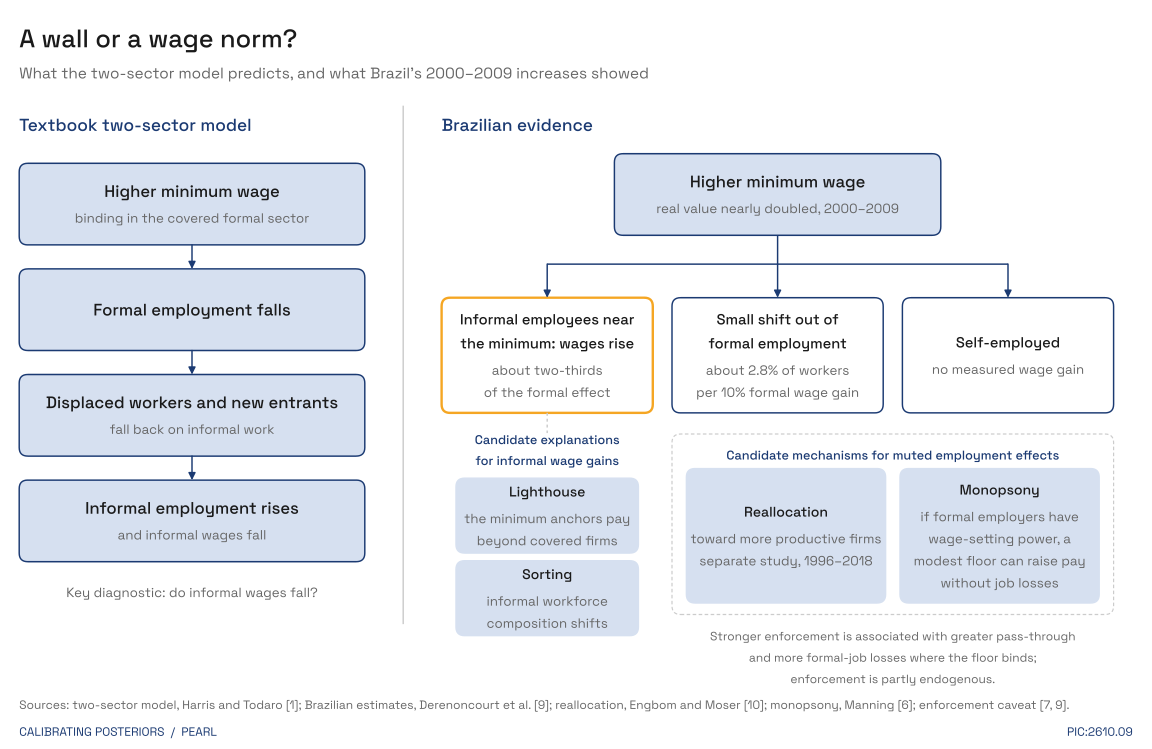
Why does the informal sector's wage rise when the legal floor is raised, rather than fall? The leading explanation is the "lighthouse" (or spillover) effect: the statutory minimum becomes an anchor or reference for pay-setting beyond the firms legally bound by it [9, 16, 17]. Employers competing for the same workers, and workers bargaining with the minimum as a focal point, pull informal wages partway toward the formal floor. In Brazil the minimum has long served as a numéraire — wages bunch not only at the minimum but at multiples of it, in both sectors [9]. A second candidate is sorting: when the formal wage rises, the composition of workers in the informal sector can shift, which alone explains part of the measured informal wage increase [9].
A third mechanism is reallocation across firms rather than into informality. When the floor rises, low-productivity formal firms may shrink or exit while higher-productivity firms absorb workers; Engbom and Moser find this reallocation, not mass job destruction, is why Brazil's employment and output effects stayed muted [10]. A fourth is monopsony: if formal employers hold wage-setting power, a modest floor can raise pay without destroying jobs [6]. Under all four mechanisms, the simple two-sector transfer story is too strong.
Two limits cut the other way. The wage gain reaches informal employees near the minimum, not the self-employed, whose earnings did not rise in Brazil at all [9]. And the mechanism depends on enforcement: the more credible the inspection and compliance regime, the more the floor passes through to informal wages — but the same enforcement is what makes formal employment losses more likely where the floor is genuinely binding [7, 9].
Competing explanations and where the camps disagree
The two camps agree on more than the debate suggests. Everyone accepts that the floor compresses the wage distribution and raises covered wages; the disagreement is about the employment margin and its sectoral incidence.
The skeptical reading holds that the developing-country evidence, when read closely, still shows the standard trade-off: more negative effects appear precisely where the minimum wage bites and is enforced, so a genuinely binding policy does carry employment costs [7]. On this account the "no effect" findings reflect weak bite and weak enforcement, not a broken model. The revisionist reading holds that the newer, better-identified studies — Brazil's own-wage reallocation elasticity of −0.28, Mexico's null aggregate effect — show the trade-off is small in practice, and that the informal sector's wage response blunts the policy's regressive potential [9, 13, 15].
The disagreement is partly about what the estimand is. A study of covered-sector workers near the floor is measuring the textbook margin and can legitimately find losses. A study of total employment in a high-informality economy is measuring the margin that matters for poverty, where substitution and reallocation can absorb much of the shock. The survey evidence shows the same estimates swinging with these choices [7]. Neither camp has a design that settles the other's question, because they are not answering the same question.
Evidence quality and limitations
The evidence is stronger than it was a decade ago but uneven. The Brazilian work is the strongest: linked administrative and survey data, a large and well-measured change in the floor, and explicit tests of wage pass-through and reallocation [9, 10]. Mexico's border doubling is close to a natural experiment, and the worker-level panel is a genuine strength [13, 14]. The wider developing-country literature is much weaker: few credible quasi-experiments, heterogeneous designs, and estimates that often do not state whether they cover the formal sector, the informal sector, or both [7].
Three specific limits deserve emphasis.
- Informality is measured inconsistently. "Informal" can mean a job without social-security registration, a worker at an unregistered firm, or the self-employed. Studies using different definitions are not directly comparable, and the self-employed — a large and poor group — are often excluded or lumped in [7, 9].
- The policy is bundled. In Brazil the minimum wage also indexes pensions and other benefits, so partial-equilibrium wage effects can overstate the pure floor. The equilibrium models that correct for this still rest on structural assumptions [10].
- Enforcement is partly endogenous. Where enforcement is stronger, both wage pass-through and formal-job losses can be larger, so cross-region comparisons can confound the policy with the enforcement regime [7, 9].
Finally, the source of variation matters. Much of the credible evidence comes from large, sustained increases (Brazil) or sharp, localized ones (Mexico's border). Whether the same magnitudes hold for modest annual adjustments — the more common real-world case — is inferred more than measured.
Counterevidence
Three findings keep the revisionist story from hardening into "the minimum wage is costless."
First, large sudden shocks can hurt. Hungary's one-step increase produced modest aggregate employment losses but concentrated, real damage among the most exposed firms [4]; the US bunching evidence also found reduced employment in tradable sectors even as total low-wage jobs held steady [3].
Second, the losses fall on the least-skilled and most protected, exactly the workers the policy is meant to help. The developing-country survey finds negative estimates concentrated among less-skilled workers in the covered formal sector [7], and the vulnerable are the group most prone to reallocation toward informality [8]. A wage floor that compresses pay can also price out the marginal worker.
Third, the self-employed gain nothing. In Brazil the informal self-employed saw no wage increase, and they are a substantial share of the informal workforce [9, 16]. The spillover reaches informal employees near the minimum; it does not reach the bottom of the informal distribution.
Verdict and calibrated confidence
Best current answer. In economies with large informal sectors, raising the minimum wage does not produce the large formal-to-informal reallocation that the textbook two-sector model predicts, and it does not depress informal wages as a whole. The reallocation is real but small — on the order of 2.8% of workers per 10% formal wage gain in Brazil — and informal wages typically rise partway toward the new floor. The effects are heterogeneous: larger where the floor binds hardest and is best enforced, concentrated among the least-skilled formal workers, and absent for the self-employed.
Confidence.
- ~85% that, in the studied large increases (Brazil 2000–2009; Mexico's 2019 border doubling), raising the minimum wage did not cause a large net shift of workers into informality.
- ~80% that informal employees' wages near the floor typically rise with the minimum wage rather than fall ("lighthouse"/spillover effect), at least where some enforcement exists.
- ~75% that measured employment losses are small on average but concentrated among the least-skilled and in the best-enforced formal sectors — so the phrase "no employment effect" overstates the case.
- ~60% that the same small-reallocation result generalizes to modest annual adjustments across a wide range of developing economies; the strongest evidence comes from unusually large or sharp changes, and the general case is inferred more than measured.
Reversal conditions and what would change the answer
This answer is provisional and would move under any of the following.
- A credible quasi-experiment in a low-enforcement, high-informality economy (much of Sub-Saharan Africa) showing large formal-to-informal reallocation after a binding increase. The current evidence is dominated by Latin America, where enforcement and wage-setting institutions are comparatively strong [7, 8].
- Worker-level evidence on the informal self-employed, not just informal employees, showing a decline in their earnings. The self-employed are the group the spillover does not reach, and their response is the least measured [9, 16].
- A design that isolates the minimum wage from bundled transfers. Where the floor indexes pensions and benefits (as in Brazil), separating the pure wage effect would test whether the muted employment result survives [10].
- Replication of the Brazilian spillover and reallocation estimates on independent data, since the sharpest numbers come from a small number of studies, and the survey literature as a whole remains heterogeneous [7, 9].
Until those tests exist, the honest summary is directional rather than precise: a higher minimum wage in a high-informality economy is less likely to push workers into informality, and more likely to pay some informal workers more, than the textbook model predicts — but it is not costless, and its gains and losses are unevenly distributed.
References
- Harris JR, Todaro MP. Migration, unemployment and development: a two-sector analysis. American Economic Review. 1970;60(1):126–142. https://www.jstor.org/stable/1807860
- Card D, Krueger AB. Minimum Wages and Employment: A Case Study of the Fast-Food Industry in New Jersey and Pennsylvania. American Economic Review. 1994;84(4):772–793. NBER Working Paper 4509. doi:10.3386/w4509.
- Cengiz D, Dube A, Lindner A, Zipperer B. The Effect of Minimum Wages on Low-Wage Jobs. The Quarterly Journal of Economics. 2019;134(3):1405–1454. doi:10.1093/qje/qjz014.
- Harasztosi P, Lindner A. Who Pays for the Minimum Wage? American Economic Review. 2019;109(8):2693–2727. doi:10.1257/aer.20171445.
- Neumark D. The Econometrics and Economics of the Employment Effects of Minimum Wages: Getting from Known Unknowns to Known Knowns. NBER Working Paper 25043. 2018. doi:10.3386/w25043.
- Manning A. Monopsony in Labor Markets: A Review. ILR Review. 2021;74(1):3–26. doi:10.1177/0019793920922499.
- Neumark D, Munguía Corella LF. Do minimum wages reduce employment in developing countries? A survey and exploration of conflicting evidence. World Development. 2021;137:105165. doi:10.1016/j.worlddev.2020.105165.
- Broecke S, Forti A, Vandeweyer M. The effect of minimum wages on employment in emerging economies: a survey and meta-analysis. Oxford Development Studies. 2017;45(3):366–391. doi:10.1080/13600818.2017.1279134.
- Derenoncourt E, Gerard F, Lagos L, Montialoux C. Minimum Wages and Informality. NBER Working Paper 34445. November 2025 (revised July 2026). doi:10.3386/w34445.
- Engbom N, Moser C. Earnings Inequality and the Minimum Wage: Evidence from Brazil. American Economic Review. 2022;112(12):3803–3847. doi:10.1257/aer.20181506.
- Lemos S. Minimum wage effects in a developing country. Labour Economics. 2009;16(2):224–237. doi:10.1016/j.labeco.2008.07.003.
- Sotomayor OJ. Can the minimum wage reduce poverty and inequality in the developing world? Evidence from Brazil. World Development. 2021;138:105182. doi:10.1016/j.worlddev.2020.105182.
- Campos-Vázquez RM, Esquivel G. The effect of doubling the minimum wage on employment and earnings in Mexico. Economics Letters. 2021;209:110124. doi:10.1016/j.econlet.2021.110124.
- Cabrera-Hernández F, Duval Hernández R. Minimum Wage and Job Transitions in Mexico. IZA Discussion Paper No. 18443. March 2026. https://docs.iza.org/dp18443.pdf
- Dube A, Lindner A. Minimum Wages in the 21st Century. NBER Working Paper 32878. 2024. doi:10.3386/w32878.
- Gindling TH. Does increasing the minimum wage reduce poverty in developing countries? IZA World of Labor. 2014:30. doi:10.15185/izawol.30.
- Gindling TH, Terrell K. Minimum wages, wages and employment in various sectors in Honduras. Labour Economics. 2009;16(3):291–303. doi:10.1016/j.labeco.2008.10.001.
- International Labour Organization. Women and Men in the Informal Economy: A Statistical Picture. 3rd ed. Geneva: ILO; 2018. https://www.ilo.org/publications/women-and-men-informal-economy-statistical-picture-third-edition