Education · Reading acquisition · Evidence synthesis
Does Phonics Teach Children to Read? Decoding, Comprehension, and the Limits of an Instructional Mandate
Teaching letter-sound correspondences systematically is one of the most reliable findings in education research. Yet countries that mandated it nationally — and tested for it — have not harvested the reading-comprehension gains their advocates promised. Both facts are real, and the tension between them is not a scandal. It is what happens when a mechanism that builds decoding is asked to deliver an outcome that decoding alone cannot produce.
Abstract
This brief asks what the best-identified evidence supports about systematic phonics instruction: does it accelerate learning to read, how large is the advantage over meaning-first approaches, and how far does any benefit extend to comprehension and to the longer run? Meta-analyses converge on a robust small-to-moderate advantage for systematic phonics on decoding, word reading, and spelling, largest for beginning and at-risk readers and clearest against weak comparison conditions. The transfer to reading comprehension is early, modest, and fragile; long-run comprehension advantages have not been demonstrated at scale, and national phonics mandates in England have not produced the comprehension gains their advocates claimed. Reading-science syntheses now agree that phonics is necessary but not sufficient, and that the point of contention is dosage, sequencing, and integration with language comprehension — not whether letters should be taught. The size of the measured advantage also depends heavily on orthographic transparency, which matters for languages such as Portuguese where decoding is easier to acquire than in English.
Systematic phonics instruction reliably and repeatedly improves early decoding, word reading, and spelling relative to little-or-no phonics instruction — a small-to-moderate effect, concentrated among beginners and struggling readers. The evidence that this advantage transfers to reading comprehension is weak, early, and contested, and large-scale phonics mandates have not delivered comprehension gains. The defensible synthesis is that phonics is necessary but not sufficient: it reliably builds the decoding half of reading while leaving the language-comprehension half to other instruction.
The question and why it matters
Few questions in education carry as much public heat as how to teach a child to read. In one corner, systematic phonics — direct, sequenced instruction in the correspondences between letters and sounds. In the other, whole-language and "balanced literacy" approaches in which children encounter meaningful texts and infer the code largely through them. The argument, waged since at least the 1950s and revived as the "reading wars" in the 1990s, has shaped national curricula, teacher training, and now statutory assessments in several countries.
The stakes are large. Reading is the gateway skill on which most later academic learning depends, and a substantial minority of children — roughly one in fourteen in the case of word-reading difficulty — struggle to acquire it. If a particular instructional method reliably reduces that struggle, adopting it matters enormously; if the claimed benefits are overstated, mandating it wastes instructional time and may crowd out the very comprehension instruction that fluent reading eventually requires.
This brief asks a bounded and answerable version of the question: across the best-identified studies, does systematic phonics instruction improve reading acquisition relative to meaning-first alternatives, how large is the advantage, and how far does it extend — from decoding to comprehension, and from the first years of school into the longer run? It closes with what the evidence implies for transparent orthographies such as Portuguese, where the learning problem is materially different from the one English-speaking research mostly studies.
Two claims that should not both be true
Two widely repeated claims sit awkwardly together:
- Phonics works. The National Reading Panel's 2000 meta-analysis and the re-analyses that followed are among the most-cited results in education research, and the effect of systematic phonics on word reading is standard textbook material.
- Mandating phonics has not fixed reading. England introduced the statutory phonics screening check in 2012 and a phonics-oriented literacy strategy before that. National pupil data and international PIRLS results do not show the comprehension improvements the policy was sold on.
A third claim, from a minority of researchers, sharpens the puzzle: when systematic phonics is compared against genuine alternative methods rather than against weak or absent phonics instruction, the advantage is said to shrink toward nothing.
All three positions can be sustained at once, and that is the key to reading the literature correctly. They are not three measurements of one quantity. They are three different comparisons: phonics against no phonics, phonics against meaning-first instruction, and a national mandate against a national counterfactual. The apparent contradiction dissolves once each is sorted by what it actually manipulates and what outcome it actually measures.
Best current answer
Phonics reliably builds decoding — the evidence here is strong. Meta-analyses across four decades agree that systematic, explicit phonics instruction produces a small-to-moderate advantage over little-or-no phonics in decoding, word reading, and spelling. The effect is largest for beginning readers and for children at risk of reading difficulty, and it is clearest when the comparison is weak (no phonics, or unsystematic incidental phonics).
The advantage over genuine alternatives is real but smaller and outcome-specific. Against a well-implemented meaning-first programme, the measured phonics advantage on word reading is smaller than the headline meta-analytic numbers suggest, and part of the dispute among researchers is about how fairly the comparison conditions were constructed.
The transfer to comprehension is weak, early, and fragile. The effect of phonics on reading comprehension is consistently smaller than its effect on decoding, and long-term follow-up studies find that the initial decoding advantage tends to fade as other children catch up. Large national mandates have not converted phonics proficiency into comprehension gains.
The honest synthesis is "necessary but not sufficient." The current mainstream position in reading science is that decoding instruction and language-comprehension instruction are complements, not rivals: phonics builds one half of reading, and reading comprehension additionally depends on vocabulary, background knowledge, and oral-language skill that code-focused instruction does not supply.
What each study design actually estimates
The literature is only confusing if the estimands are blurred. Three families of evidence answer three different questions.
Meta-analyses of controlled trials. These estimate the effect of adding or substituting phonics instruction within a study, against a specified comparison. Their headline effect sizes are the source of the "phonics works" claim, and their size swings with the comparison condition — large against no phonics, smaller against a real alternative.
Long-term follow-up studies. These ask whether an early decoding advantage persists. They generally find convergence: the gap in word reading narrows over the following years, so the case for phonics as a durable comprehension lever is weaker than the case for it as an early decoding lever.
Natural experiments and national rollouts. These estimate what happens when a whole system changes its reading policy. They are the only designs that can speak to whether a mandate works at scale, and they are the designs that most often find null comprehension effects — partly because a mandate is a blunt instrument that changes instruction far less cleanly than a trial does.
Reading each family as if it answered the others' question is the central error in public argument about phonics.
The core evidence: phonics reliably builds decoding
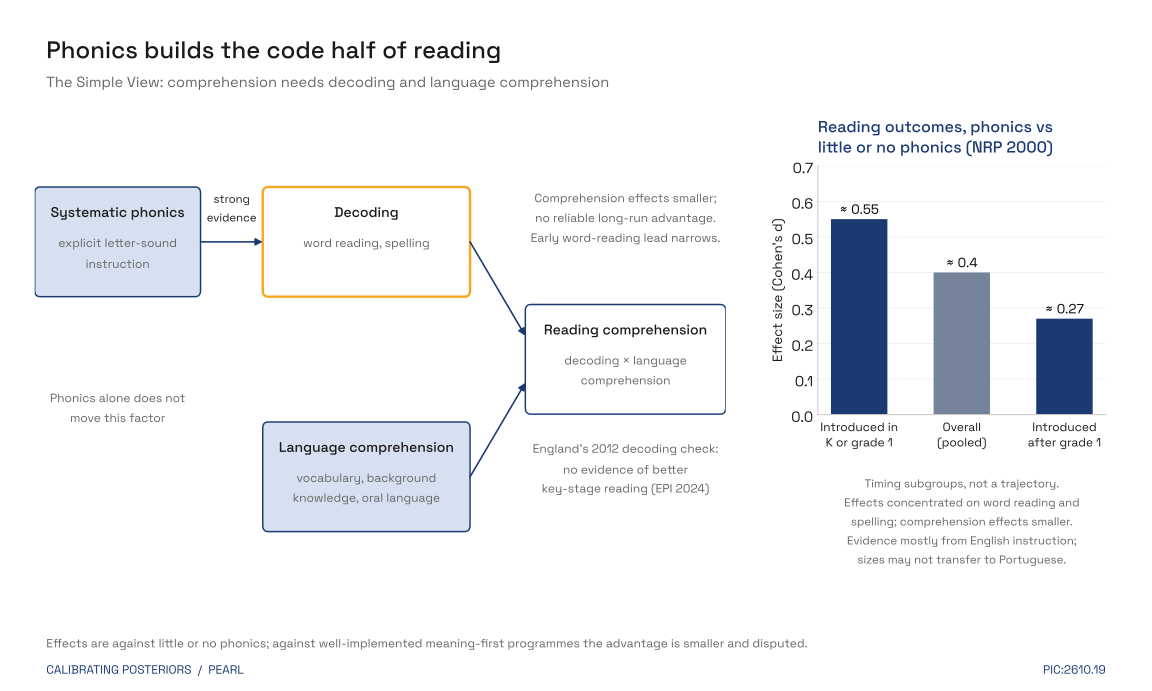
The anchor is the National Reading Panel's 2000 meta-analysis, reported by Ehri and colleagues in 2001. Pooling controlled studies, it found a statistically robust advantage for systematic phonics instruction on reading, with an overall effect around d ≈ 0.4 — small to moderate in conventional terms. The effect was largest for kindergarten and first-grade children (roughly d ≈ 0.55) and smaller when phonics was introduced after first grade (roughly d ≈ 0.27), consistent with the idea that the earlier window is where code instruction does most of its work. The Panel also found the effects concentrated on word reading and spelling rather than on reading comprehension.
Successive reviews broadly reproduce this shape. Torgerson and colleagues' 2006 systematic review for the UK Department for Education found a small positive effect on word reading with limited evidence of comprehension benefit, and their 2019 "tertiary" review of the review literature reached a similar verdict: reliable gains for word reading, weak or absent evidence for comprehension and for long-term transfer. A reanalysis of the National Reading Panel data by Camilli and colleagues in 2003 produced a smaller and more condition-dependent effect, underlining how much the estimate depends on the comparison and the outcome chosen — a point the field has never fully settled.
The subtler question is not whether letters should be taught but whether the print component is the active ingredient. A 2024 meta-analysis by Stalega and colleagues pooled 38 studies (293 effect sizes, 3,880 children) of phonological-awareness instruction without print. Pure phonological training produced a moderate gain on reading-related outcomes (g ≈ 0.57), but it was distinctly less effective than print-based instruction such as phonics (g ≈ −0.54 in the head-to-head comparison), and weaker for word reading specifically. The letters, not just the sounds, appear to do the work that reaches reading.
Does it transfer to comprehension?
This is where the strong claims weaken. If phonics built reading comprehension as reliably as it builds decoding, the policy case would be settled. The evidence does not support that strong claim.
Ehri and colleagues already reported that comprehension effects were smaller than decoding effects. Suggate's 2016 meta-analysis of long-term outcomes is more pointed: following children over several years after the intervention ended, the initial advantage of phonics over control approaches on word reading largely disappeared, and there was no reliable long-run comprehension advantage. Hall and colleagues' 2023 meta-analysis of reading interventions for students with or at risk of dyslexia found that code-focused "foundational skills" interventions produce moderate effects on foundational skills themselves but substantially smaller effects on standardized comprehension — and that the reviews of the past decade repeatedly describe the comprehension transfer as the weak link.
The theoretical picture explains why this should be expected rather than disappointing. Under the widely used "Simple View," reading comprehension is the product of decoding and language comprehension. Phonics moves the decoding factor; it does not, on its own, move language comprehension. A child who can decode but has limited vocabulary or background knowledge will read words accurately and understand little. This is precisely why the most defensible reading-science syntheses — Castles, Rastle and Nation's 2018 "Ending the Reading Wars" is the canonical example — conclude that both camps were partly right: systematic phonics is necessary, and a balanced programme that also builds language comprehension is necessary.
The scale problem: mandates and screening checks
The most informative evidence for policy is the hardest to get cleanly, and it is where the "phonics fixes reading" story breaks.
Scotland's Clackmannanshire study (Johnston and Watson, 2005) is the classic natural experiment in phonics's favour. Children taught synthetic phonics from the start of school showed large and persistent advantages in word reading and, especially, spelling by the end of primary — the often-quoted figures of a multi-year advantage in spelling and decoding. The comprehension advantage, by contrast, was far smaller, measured in months rather than years. The study was also small and not randomized, and its comparison conditions were not pure whole-language programmes, so it demonstrates that strong synthetic phonics produces strong decoding without establishing that it produces strong comprehension.
England's experience points the same way. The National Literacy Strategy ("Literacy Hour"), introduced in 1998, produced modest gains in primary English — Machin and McNally (2008) estimate a few percentage points — from a broad whole-class framework rather than from phonics alone. Then came the statutory phonics screening check in 2012, an assessment of decoding of nonwords that made early phonics proficiency a school accountability metric. The Education Policy Institute's 2024 analysis of national pupil-level data (Campbell and Kelly) found no evidence that the check improved key-stage reading results: the pre-existing upward trend stalled after its introduction, there was no narrowing of attainment gaps by the end of primary, and PIRLS results gave no indication of improved reading skill. The report also found that children who failed the check were more likely to be newly recorded with special educational needs, raising the possibility of a labelling side effect. A mandate plus a test for decoding did not buy comprehension.
The lesson is not that phonics failed but that a decoding mandate is a decoding instrument. Scaling it changes what schools teach in the early years; it does not, by itself, supply the language-comprehension instruction that the Simple View says comprehension requires.
Orthography: what transfers to Portuguese and other transparent languages
Almost all of the contested research was conducted in English, which is close to the worst case for learning an alphabetic code. Seymour, Aro and Erskine's 2003 study of foundation literacy across thirteen European orthographies found that children in most shallow (transparent) orthographies become accurate and fluent at basic decoding within the first school year, whereas English children take roughly two-and-a-half times as long. Portuguese was among the slower orthographies in their sample, less transparent than Spanish, Italian or Finnish but considerably more regular than English. Ziegler and Goswami's 2005 psycholinguistic grain-size theory gives the mechanism: children learning shallow orthographies can map letters to sounds at a fine grain almost immediately, while opaque orthographies force larger-unit and context-dependent strategies that take longer to assemble.
The implication for a language such as Portuguese is that the decoding problem phonics solves is easier in the first place, so the marginal benefit of intensive, English-style synthetic phonics is plausibly smaller — there is less irregularity for systematic instruction to tame. The comprehension half of the equation, by contrast, is unaffected by orthographic transparency: vocabulary and oral-language comprehension remain the binding constraints wherever the instruction happens. The strong general claim "phonics is the answer" is weakest precisely where the orthography makes decoding easy, and the case for language-comprehension instruction is correspondingly stronger.
Counterevidence
The case against strong phonics claims is not merely about magnitude; some of it challenges the direction of the small effects.
Jeffrey Bowers's 2020 critique in Educational Psychology Review argued that the apparent advantage of systematic phonics over alternative methods is an artefact of weak comparison conditions and selective study inclusion. For instance, when phonics is compared against genuinely balanced instruction that also includes attention to meaning, the difference shrinks or disappears. Fletcher, Savage and Vaughn's 2021 reply disputed several of Bowers's coding and inclusion decisions and argued that the effects remain educationally meaningful and that Bowers's reanalysis tilted the evidence toward nullity. Buckingham (2020) similarly defended the phonics evidence base. The exchange is genuinely unresolved and is not a case of one side having the better data set; it is a case of reasonable analysts disagreeing about how studies should be grouped and compared.
There is also a distinct caution about how much of the phonics benefit is simply the benefit of explicit instruction in any skill. Explicit teaching of reading tends to outperform incidental acquisition, so part of the measured phonics effect may be the effect of direct instruction rather than of phonics specifically. Disentangling the two is hard with the designs that dominate the literature.
Evidence quality and coverage limits
Three limits bound this synthesis.
First, the comparison condition is decisive and often loosely specified. "Systematic phonics versus alternative methods" is not one contrast but several, and the effect size can vary by a factor of two depending on which alternative and which outcome are chosen. Many studies blur the conditions.
Second, the long-run and comprehension evidence is thin. The best follow-up studies are few, and national-rollout designs cannot isolate phonics from the many other simultaneous changes. There is no large, preregistered, multi-country trial that randomizes whole-school reading programmes and follows children to mature comprehension.
Third, the evidence is English-heavy. Extrapolating effect sizes to transparent orthographies such as Portuguese is speculative, and the direction of the bias — smaller decoding benefit where decoding is already easy — is grounded in theory and cross-linguistic observation more than in trials.
Calibrated confidence and reversal conditions
- ~95% confident that systematic, explicit phonics instruction improves early decoding, word reading, and spelling relative to little-or-no phonics instruction, most for beginners and struggling readers.
- ~70% confident that the advantage over a well-implemented meaning-first programme is real but smaller than headline meta-analyses suggest, and depends heavily on the comparison and the outcome.
- ~75% confident that the transfer to reading comprehension is early, modest, and does not reliably persist, and that code-only instruction cannot substitute for language-comprehension instruction.
- ~70% confident that a national phonics mandate alone will not raise reading comprehension, as England's screening-check experience suggests.
- ~60% confident that the marginal decoding benefit of intensive synthetic phonics is smaller in transparent orthographies such as Portuguese than the English literature implies.
Conditions that would move these estimates: a large preregistered multi-site trial randomizing school reading programmes with long-run comprehension endpoints (would raise confidence in transfer if positive); a well-powered study using genuinely balanced comparison conditions (would sharpen or dissolve the Bowers–Fletcher dispute); and cross-linguistic trials in Portuguese and other shallow orthographies (would test the orthographic moderation directly).
The provisional bottom line
Systematic phonics is one of the better-evidenced instructional findings in education, and that evidence is narrower than its reputation. It reliably builds decoding, word reading, and spelling, and it does so most for the children who most need help. It does not, on the evidence to date, reliably build reading comprehension, and turning it into a national mandate has not changed that. The reading wars persist not because the data are indecisive about decoding but because the debate conflates two different outcomes and treats one mechanism as if it were the whole of reading. The durable conclusion, which both camps now largely accept, is that phonics is the necessary code half of reading and that comprehension instruction is the necessary other half — and that in transparent orthographies such as Portuguese, the code half is the easier half to secure.
References
- National Reading Panel. Teaching children to read: an evidence-based assessment of the scientific research literature on reading and its implications for reading instruction. Washington, DC: National Institute of Child Health and Human Development; 2000. https://www.nichd.nih.gov/sites/default/files/publications/pubs/nrp/Documents/report.pdf
- Ehri LC, Nunes SR, Stahl SA, Willows DM. Systematic phonics instruction helps students learn to read: evidence from the National Reading Panel's meta-analysis. Review of Educational Research. 2001;71(3):393–447. doi:10.3102/00346543071003393
- Torgerson C, Brooks G, Hall J. A systematic review of the research literature on the use of phonics in the teaching of reading and spelling. DfES Research Report 711. London: Department for Education and Skills; 2006. https://dera.ioe.ac.uk/id/eprint/14288/
- Torgerson C, Brooks G, Gascoine L, Higgins S. Phonics: reading policy and the evidence of effectiveness from a systematic 'tertiary' review. Research Papers in Education. 2019;34(2):208–238. doi:10.1080/02671522.2017.1420816
- Camilli G, Vargas S, Ryan S. Teaching children to read: the fragile link between science and educational practice. Phi Delta Kappan. 2003;84(9):648–667. doi:10.1177/003172170308400902
- Stalega M, Kearns D, Bourget J, Bayer N, Hebert M. Is phonological-only instruction helpful for reading? A meta-analysis. Scientific Studies of Reading. 2024;28(6):614–635. doi:10.1080/10888438.2024.2340708
- Suggate SP. A meta-analysis of the long-term effects of phonemic awareness, phonics, fluency, and reading comprehension interventions. Journal of Learning Disabilities. 2016;49(1):77–96. doi:10.1177/0022219414528540
- Hall C, Dahl-Leonard K, Cho E, et al. Forty years of reading intervention research for elementary students with or at risk for dyslexia: a systematic review and meta-analysis. Reading Research Quarterly. 2023;58(2):285–312. doi:10.1002/rrq.477
- Castles A, Rastle K, Nation K. Ending the reading wars: reading acquisition from novice to expert. Psychological Science in the Public Interest. 2018;19(1):5–51. doi:10.1177/1529100618772271
- Johnston RS, Watson JE. The effects of synthetic phonics teaching on reading and spelling attainment: a seven year longitudinal study. Edinburgh: Scottish Executive Education Department; 2005. https://www.gov.scot/publications/effects-synthetic-phonics-teaching-reading-spelling-attainment-seven-year/
- Machin S, McNally S. The literacy hour. Journal of Public Economics. 2008;92(5–6):1441–1462. doi:10.1016/j.jpubeco.2007.11.008
- Campbell T, Kelly J. Reading the data: what can quantitative analyses tell us about the national impacts of the phonics screening check? London: Education Policy Institute; 2024. https://epi.org.uk/wp-content/uploads/2024/11/FINAL_PSC-report-Nov.pdf
- Seymour PHK, Aro M, Erskine JM. Foundation literacy acquisition in European orthographies. British Journal of Psychology. 2003;94(2):143–174. doi:10.1348/000712603321661859
- Ziegler JC, Goswami U. Reading acquisition, developmental dyslexia, and skilled reading across languages: a psycholinguistic grain size theory. Psychological Bulletin. 2005;131(1):3–29. doi:10.1037/0033-2909.131.1.3
- Bowers JS. Reconsidering the evidence that systematic phonics is more effective than alternative methods of reading instruction. Educational Psychology Review. 2020;32(3):681–705. doi:10.1007/s10648-019-09515-y
- Fletcher JM, Savage R, Vaughn S. A commentary on Bowers (2020) and the role of phonics in reading instruction. Educational Psychology Review. 2021;33(3):1249–1274. doi:10.1007/s10648-020-09580-8
- Buckingham J. Systematic phonics instruction belongs in evidence-based reading programs: a response to Bowers. Educational and Developmental Psychologist. 2020;37(2):105–113. doi:10.1017/edp.2020.12