Education economics · Cognitive psychology · Evidence synthesis
Does Schooling Make You Smarter, or Just More Knowledgeable?
The headline is that a year of schooling buys one to five IQ points. The caveat is which tests move: natural experiments that separate school days from mere aging find that the gains concentrate in knowledge-loaded measures, while reasoning tests keep mostly growing with age. Whether schooling touches the general factor of intelligence is genuinely unsettled.
Abstract
The claim "schooling raises intelligence" has been one of the most reproducible findings in the social sciences — and one of the most misleading when told in one sentence. A meta-analysis of 42 datasets finds that an additional year of schooling improves intelligence-test scores by 1 to 5 IQ points across three quasi-experimental designs. But designs that hold age constant — first the classic school-entry-cutoff studies in children, later day-level variation in Swedish conscripts and a German high-school reform — tell a sharper story: the gains are concentrated in crystallized measures (vocabulary, comprehension, technical knowledge), while fluid measures (spatial reasoning, logic, matrices) keep pace with aging but do not obviously follow the school calendar. Studies asking whether the gains reach the general factor g disagree: two analyses of the same latent models find schooling improving specific skills but not g, while a non-peer-reviewed reanalysis argues the opposite. In children, a 2022 quasi-experiment finds real fluid gains, smaller than the crystallized ones, alongside a striking result: two years of schooling outweighed a lifetime's contribution of socioeconomic status or a polygenic score — without changing anyone's rank order. A 2025 randomized trial in Indian primary schools offers one mechanism: sustained effortful thinking, with or without academic content, reduces within-test fatigue by about a fifth. This brief separates what is measured from what is inferred and states the exact conditions under which each headline would flip.
Extra schooling robustly raises knowledge-loaded cognitive-test scores (about 1–5 IQ points per year, converging across three quasi-experimental designs), but the best-identified day-level and reform studies find the gain concentrated in crystallized measures while fluid reasoning tracks aging, not school days; whether the general factor g moves at all remains contested, and the honest answer is 'scores: yes, reliably; the latent trait: unresolved.'
The question: why one headline hides two literatures
"More education makes people smarter" is one of the most repeated and most tested sentences in the social sciences, and one of the easiest to tell wrong. The scientific literature splits cleanly in two, and the split is not about whether schooling helps as much as about what is measured when a paper says "intelligence."
The modern standard distinction comes from the crystallized / fluid division: crystallized ability is the stored part — vocabulary, general knowledge, comprehension, arithmetic — the kind of thing a school explicitly fills. Fluid ability is the reasoning part — pattern recognition, spatial logic, abstract problem-solving, the kind of test assumed to be relatively content-free, such as Raven's matrices — the kind of thing people usually mean when they say "smart." A third concept, the general factor g, is the statistical common core that emerges when many different tests are administered together; it is what an IQ score is often supposed to approximate, and it is impossible to observe directly.
The puzzle this brief addresses is a pattern, not a single study. Papers that average across many kinds of tests conclude that schooling raises intelligence broadly and durably. Papers that hold age constant — and therefore separate "a year of being taught" from "a year of just getting older" — consistently find that the gains land on the knowledge-loaded and skill-loaded tests, while the reasoning tests move with age and not with the school calendar. Both literatures are well-identified. They appear to be measuring different things and calling them by the same name.
Why it matters
This is not an academic dispute about psychometrics. Four practical decisions turn on it.
First, education policy. If an extra school year reliably raises knowledge-based scores (vocabulary, comprehension, memory) but does not move the general reasoning factor, then "extend compulsory schooling to build cognitive capacity" and "improve the quality of instruction" are different claims with different evidence. The per-day returns found in Sweden — about a fifth of a standard deviation of crystallized score per full school year — are real but narrow: they describe knowledge and skill accumulation, not general-purpose brain training.
Second, how to read group differences. Population-level IQ and "cognitive ability" survey batteries are, in part, measures of schooling exposure. Two groups can differ on such tests because they attended school for different lengths or at different ages, with no implication about some deeper trait. Reading a schooling-driven test gap as an intelligence gap is a category error that the underlying studies explicitly warn against.
Third, cognitive aging and dementia policy. Whether education adds "cognitive reserve" that slows decline, or merely raises the peak level from which decline starts, changes what an old-age policy can expect from schooling. The best-identified aging studies mostly find effects on the level of late-life cognition, with little or no effect on the rate of decline — a distinction with direct implications for how promising "education as dementia prevention" really is.
Fourth, the real benefits must not be abandoned with the name. If the correct account is "schooling delivers knowledge, practiced attention, and an endurance for sustained effort," that is still among the largest and most reproducible returns found anywhere in the social sciences; it just is not what the word "smarter" usually promises.
The headline: an extra school year buys one to five IQ points
The most-cited quantitative anchor is Ritchie and Tucker-Drob's 2018 meta-analysis in Psychological Science: 142 effect sizes from 42 datasets and more than 600,000 participants, restricted to studies that address selection into schooling — the fact that smarter children stay in school longer. Their pooled estimate is that an additional year of education raises intelligence-test scores by 3.4 IQ points (standard error 0.5), and the design-by-design results bracket the honest range:
| Design | Example | Estimate per extra year |
|---|---|---|
| Control for prior ability | Longitudinal cohorts with a childhood test score | 1.2 IQ points |
| Compulsory-schooling reform as instrument | Norway 1960s reform; UK 1947 leaving age | 2.1 IQ points |
| School-entry age cutoff (regression discontinuity) | Comparing same-age children one grade apart | 5.2 IQ points |
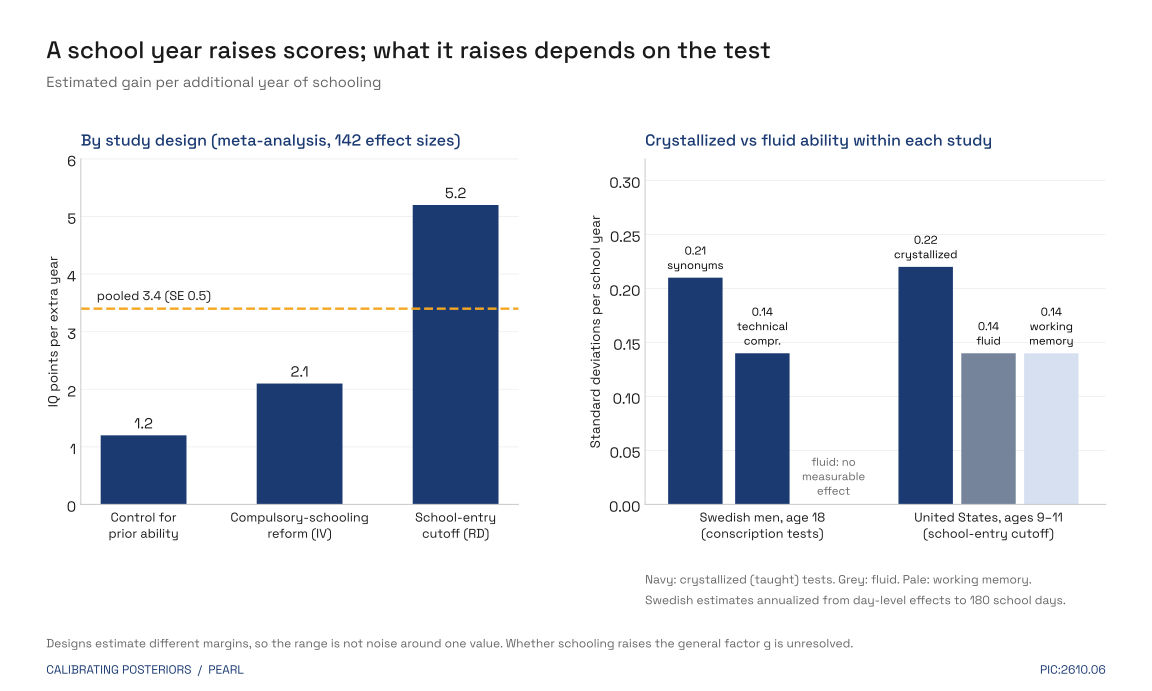
Each design earns its estimate in a different way, and each has a distinct weakness. The control-prior-ability design covers the whole schooling range but its control for preexisting ability is only partial. The policy-change design is causally cleanest but estimates a local effect on the would-have-dropped-out margin. The age-cutoff design — pioneered by Cahan and Cohen in 1989 — is powerful but confined to adjacent grades in primary school, and the original meta-analysis could not show whether those gains persist into adulthood. The headline "1 to 5 IQ points" is therefore not a figure of speech; it is the range across genuinely different questions.
The most famous single estimate sits in that range. Brinch and Galloway exploited Norway's 1960s reform that raised compulsory schooling from seven to nine years across the middle-teenage years, comparing over 100,000 men tested for IQ at age 19. The reform raised IQ by about 0.6 points on average; translated with an instrumental variable, an additional year of schooling raised IQ by 3.7 points — smaller than the 5.1 points a naive regression would produce, confirming that selection inflated the naive number. The authors also estimated that this one reform accounted for roughly a third of the gain in that period's Flynn effect — the secular rise in IQ scores — a result that sits at the center of everything this brief is about.
The two batteries disagree
The discomfort begins when a study measures crystallized and fluid ability in the same people around the same schooling variation.
The cleanest such design is Swedish conscription. Carlsson, Dahl, Öckert and Rooth exploited the fact that almost all 18-year-old Swedish men took a four-part military cognitive battery on a date assigned quasi-randomly: after flexibly controlling for birth date, parish and expected graduation, both age at test and number of school days vary essentially randomly. An extra ten school days raised the two crystallized tests — synonyms and technical comprehension — by about 1% of a standard deviation each, implying a full Swedish school year (180 days) adds roughly 0.21 and 0.14 standard deviations of score. Crucially, extra non-school days had almost no effect on those same tests: mere experience didn't do it. And the two fluid tests — spatial ability and logic — showed the mirror image: no measurable schooling effect, only a small effect of aging. Schooling, in this design, adds what is taught and almost nothing to what is usually meant by raw reasoning.
A German high-school reform (the G8 restructuring, which compressed academic-track schooling from nine years to eight while keeping the curriculum) produced the same shape. Sahra Dahmann's published version found that, on average, the extra instructional time did not significantly improve either crystallized or fluid intelligence for 17-year-olds, with only suggestive gains for boys in numeracy — the flip side of the reform, studied in the same setting, showed fluid reasoning if anything slightly lower among accelerated students. The safest reading is that instructional intensity during adolescence buys knowledge, not reasoning.
Against that, the childhood evidence is more optimistic for fluid. Judd, Sauce and Klingberg used a school-entry cutoff design in about 6,500 American children aged 9–11 with separate crystallized, fluid and working memory batteries. A year of schooling contributed 0.22 SD to crystallized, 0.14 SD to fluid and 0.14 SD to working memory — fluid moved, just less than crystallized (the ratio of schooling's effect to one year of age was 1.1 for crystallized but 0.54 for fluid). Their most striking finding: two years of schooling outweighed the entire lifetime contribution — since birth — of socioeconomic status or of a polygenic score on those abilities, while never changing anyone's rank order. The needle, then, is not "schooling never touches fluid ability" but "the fluid response is smaller, age-dependent, and concentrated in childhood."
Does the gain touch general intelligence at all?
The second fight is about g: even if schooling raises batteries of tests, does it raise the underlying common factor, or just the specific tests?
Ritchie, Bates and Deary asked exactly this in the Lothian Birth Cohort — about 1,100 Scots tested at age 11 and again at 70, with education in between. They fitted three structural models: schooling acting on g alone; on g plus specific skills; on specific skills only. The best fit was the third: education improved several specific abilities but not the general factor — evidence against "far transfer" to intelligence itself. A 2022 replication preprint by Lasker and Kirkegaard, on about 4,000 American men in the Vietnam Experience Study tracked from around age 20 to 37, reproduced that conclusion: schooling's effects on test scores were specific, not general. (This for the record is the thesis also known, crudely, as "schooling just makes better test-takers," and it is a preprint; it has not completed peer review.)
The stable fact in this dispute is that both camps agree the raw gains are real — the disagreement is about whether the shared factor moves. And precisely that hinge is contested. An independent reanalysis of the original Lothian data, published only as an informal blog essay in 2024, found that the education-on-g conclusion depended on the model-selection procedure used by the authors: a standard forward-selection approach chose a model in which education does act on g, reversing the published conclusion. Because the reanalysis is not peer-reviewed and the original study never released its full modeling details, the correct position is that the score-versus-construct question is unresolved — both directions are currently defended with the same famous dataset. This is the single most important reason this brief's answer is two-headed.
Mechanisms: what a school year actually does
If the score gains are real but their breadth is contested, the natural next question is why a year of schooling helps a test battery at all. The evidence points to at least four channels, which the strongest studies deliberately separate.
1. Delivered content. The crystallized tests are taught. Vocabulary, comprehension, mathematical technique and technical background are the curriculum. Carlsson and colleagues' day-level result is almost a clean-slate demonstration that non-school experience does not substitute for it; the hours in class are the hours it is acquired.
2. Cognitive endurance. A 2025 Quarterly Journal of Economics trial by Brown, Kaur, Kingdon and Schofield randomised about 1,600 primary-school children in low-income Indian schools into extra daily time in sustained effortful thinking — either math problems or purely non-academic games like mazes and tangrams — against a control. Both arms cut within-test performance decline by about a fifth (22%), raised classroom attentiveness, and improved school performance by 0.09 standard deviations. The conclusion, stated carefully by the authors, is that the experience of effortful thinking itself builds an endurance for sustained mental work. That is a genuinely domain-general capacity — it would help on any long, effortful test, including fluid batteries — and it may be a large part of why schooling helps test performance without obviously raising g.
3. Test familiarity and attention strategy. Schooling teaches the meta-skills that their own tests reward: working under time pressure, sitting another timed session, allocating attention, checking steps. Quasi-experimental work in young children (Cahan and Cohen's age-cutoff studies) shows the schooling effect is smallest on the tests that resemble nothing taught in class — an observation consistent with a large familiarity-and-strategy component.
4. Later-life pathways. At older ages the schooling effect looks bigger than a childhood intervention's fade-out would predict, and the aging evidence suggests a large share runs through the life that schooling buys rather than through a fixed cognitive reserve. A 2025 Demography study using nonparametric bounds on the US Health and Retirement Study — deliberately upper-bound, not point estimates — found it cannot rule out small or zero effects of moving from primary to secondary schooling on old-age memory, while finding a robust positive effect of the secondary to tertiary move. Compulsory-schooling studies in Britain (Banks and Mazzonna, 1947 leaving-age reform) found sizable later-life memory gaps estimated around half a standard deviation of memory per extra grade — but at the margin of the pupils who would otherwise have left at 14, a different population from today's graduate margin. Recent register-based mediation work attributes roughly a third of the late-life schooling effect to labor-force participation (a cognitively engaged job, later retirement) rather than to education acting alone. The aging literature's consistent pattern is level, not slope: schooling raises where the older adult stands cognitively; whether it slows the rate of decline is close to null in the best designs.
What no study yet separates
The strongest single summary is that the average effect is real, the crystallized part is robust, the fluid part is small, age-dependent and mostly a childhood phenomenon, and the general factor question is unsettled. Before stating confidence, four structural limits make a one-number answer dishonest.
- Different margins, different people. Policy-change estimates describe the would-have-dropped-out; age-cutoff estimates describe every child at one birthday; the control-prior estimates describe the whole distribution. These are different interventions with no reason to share one effect, and the meta-analytic range 1–5 points is largely the range of the margins themselves.
- Age windows. Fluid ability appears most responsive in primary school and nearly unresponsive in late adolescence (the Swedish conscript design finds exactly zero per day). A single "schooling raises IQ" hides, systematically, whose IQ and at what age.
- Battery choice. Whether a study finds a fluid effect depends on which reasoning tests it administers and on whether the test rewards attention and endurance as much as reasoning. The QJE endurance result implies some of what looks like a "fluid gain" may be an attention gain measured on a reasoning test.
- The g debate's controls. The latent-factor literature (RBD; the 2022 replication) depends on model-selection and measurement decisions that are demonstrably capable of flipping the conclusion, and the published original did not release sufficient detail to settle it. Both directions remain live.
There is also the standard caveat for all of this literature: publication bias and analyst degrees of freedom inflate headline effects everywhere, and the Ritchie–Tucker-Drob meta-analysis' own publication-bias corrections still landed in the 1–5 range, so the direction — if not the exact point — survives that check.
Best current answer
Schooling reliably raises cognitive-test scores, and the gain is genuinely large — but it is not about what most people mean by "smarter." The score gain per year is on the order of 1–5 IQ points and concentrated in crystallized (knowledge, vocabulary, comprehension, skills) and attention-endurance measures; fluid reasoning responds mainly in childhood and weakly after; whether the general factor g moves at all is currently unresolved and honestly contested. "Education builds general intelligence" is not what the well-identified evidence shows. "Education delivers knowledge, practiced attention, and cognitive endurance — and those are among the largest reproducible returns in the social sciences" is supported.
Calibrated confidence:
- ~90% that an additional year of schooling raises a conventional composite intelligence-test score, at least in the 1–5 point range across margins, with effects that persist into later life at the level (not slope). Converging designs, incl. one very large instrumented reform.
- ~75% that the crystallized gains clearly exceed the fluid gains at the same margin, and that fluid gains are small-to-zero outside childhood. Supported by the two sharpest day-level/reform designs; weakened by Judd et al.'s positive childhood fluid estimates.
- ~55–65% that schooling does not raise the general factor g — i.e., the "specific skills, not g" account. This is the least settled claim in the literature: two latent-model analyses and one replication agree, but the model-selection sensitivity demonstrated by the 2024 informal reanalysis means the opposite conclusion is currently also defensible on the same data.
- ~80% that effort-based training (schooling's endurance channel) is a real, transferable mechanism for test gains, per the QJE trial.
Reversal conditions. My confidence would fall sharply if (a) a well-identified, pre-registered multi-battery study finds fluid gains comparable to crystallized gains at the same adolescent/young-adult margin, or (b) the latent-factor dispute resolves in favor of the "acts on g" models under transparent released code on the original and the replication data. It would rise if a second day-level design outside Sweden replicates zero fluid response, or if the endurance result replicates in richer settings.
The gap and the routing decision. Daily evidence work now hits its limit: the open question is not "what do the existing studies say" but "what does schooling do to fluid versus crystallized ability at one well-defined margin in one sample." The cheapest feasibility check for a future project is whether any reform- or cutoff-linked dataset carries a multi-subtest battery with separate crystallized and fluid indicators (the Swedish conscription data from recent cohorts and a German G8 cohort are the two natural candidates) — and whether that dataset has a schooling shock with adequate power to resolve a fluid effect of roughly 0.1 SD. Until such a dataset is located and the analysis is registered, the answer above — scores yes, fluid weakly, g unresolved — is the best evidence supports.
References
- Ritchie, S. J., & Tucker-Drob, E. M. (2018). How much does education improve intelligence? A meta-analysis. Psychological Science, 29(8), 1358–1369. https://doi.org/10.1177/0956797618774253
- Brinch, C. N., & Galloway, T. A. (2012). Schooling in adolescence raises IQ scores. Proceedings of the National Academy of Sciences, 109(2), 425–430. https://doi.org/10.1073/pnas.1106077109
- Carlsson, M., Dahl, G. B., Öckert, B., & Rooth, D.-O. (2015). The effect of schooling on cognitive skills. Review of Economics and Statistics, 97(3), 533–547. https://doi.org/10.1162/rest_a_00501
- Dahmann, S. C. (2017). How does education improve cognitive skills? Instructional time versus timing of instruction. Labour Economics, 47, 35–47. https://doi.org/10.1016/j.labeco.2017.04.008
- Judd, N., Sauce, B., & Klingberg, T. (2022). Schooling substantially improves intelligence, but neither lessens nor widens the impacts of socioeconomics and genetics. npj Science of Learning, 7, 33. https://doi.org/10.1038/s41539-022-00148-5
- Ritchie, S. J., Bates, T. C., & Deary, I. J. (2015). Is education associated with improvements in general cognitive ability, or in specific skills? Developmental Psychology, 51(5), 573–582. https://doi.org/10.1037/a0038981
- Lasker, J., & Kirkegaard, E. O. W. (2022). The generality of educational effects on cognitive ability: A replication. PsyArXiv preprint. https://doi.org/10.31234/osf.io/8s2vx
- Brown, C., Kaur, S., Kingdon, G., & Schofield, H. (2025). Cognitive endurance as human capital. The Quarterly Journal of Economics, 140(2), 943–1002. https://doi.org/10.1093/qje/qjae043
- Amin, V., Behrman, J. R., Fletcher, J. M., Flores, C. A., Flores-Lagunes, A., & Kohler, H.-P. (2025). Does schooling improve cognitive abilities at older ages? Causal evidence from nonparametric bounds. Demography, 62(2), 515–541. https://doi.org/10.1215/00703370-11865131
- Banks, J., & Mazzonna, F. (2012). The effect of education on old age cognitive abilities: Evidence from a regression discontinuity design. The Economic Journal, 122(560), 418–448. https://doi.org/10.1111/j.1468-0297.2012.02499.x
- Cahan, S., & Cohen, N. (1989). Age versus schooling effects on intelligence development. Child Development, 60(5), 1239–1249. https://doi.org/10.2307/1130797
- Gusev, S. (2024). Does education increase intelligence and does it matter? Informal reanalysis of Ritchie, Bates & Deary (2015), The Infinitesimal (Substack). https://theinfinitesimal.substack.com/p/does-education-increase-intelligence