PEARL · Brazil · Exploratory empirical study
Ideological Orientation and Empirical Content in Brazilian Academic Abstracts
An exploratory content analysis of CAPES theses and dissertations and SciELO articles finds a pronounced leftward asymmetry among abstracts assigned an ideological stance. Most abstracts receive no aggregate stance, and a majority describe data. The distributions vary substantially across fields.
Abstract
We examine ideological orientation and research characteristics in 5,213 CAPES humanities and applied social science abstracts from 2021–2024 and 4,000 SciELO Brazil research-article abstracts from 2010–2025. Supplementary samples contain 540 health-science abstracts and 846 policy-search records, 31 of which overlap the main CAPES sample. Language-model annotation follows an explicit Portuguese instrument separating economic and cultural stance, political subject matter, normative language, data description, hypotheses and inference design. CAPES estimates are weighted by field-year population; SciELO estimates are unweighted. An aggregate stance is assigned to 25.9% of CAPES and 23.6% of SciELO abstracts. Among those assigned a stance, 90.7% and 96.8%, respectively, are classified to the left. Data are described in 62.8% and 56.6%; explicit testable hypotheses occur in 10.5% and 7.4%. Policy verdicts also differ across the study's ideological policy categories. These results describe model-assigned properties of sampled abstracts. They establish a marked descriptive asymmetry within this instrument, while leaving author ideology, label accuracy and causal ideological bias unidentified.
Leftward labels account for 90.7% of stance-assigned CAPES abstracts and 96.8% of stance-assigned SciELO abstracts; 74.1% and 76.4% of all abstracts receive no aggregate stance. Data description is common despite infrequent explicit hypotheses and causal-design labels.
Research question and contribution
How frequently do Brazilian academic abstracts express an ideological position, in which direction, and in what relationship to their research methods? Public debate often bundles these questions into a single claim about ideological bias. They concern different objects. A distribution of expressed positions describes a corpus. Bias additionally concerns whether the treatment of evidence or competing arguments depends on political commitments in ways that distort inference.
This study analyzes the presentation of research in two sources: the CAPES catalogue of Brazilian theses and dissertations and the SciELO Brazil journal collection [1, 2]. Its contribution is a joint description of ideological stance and observable research characteristics across disciplines. The unit is an abstract. The estimands are proportions receiving specified content labels within the selected sampling frames, rather than the political preferences of scholars or the quality of their complete works.
Automated annotation makes a corpus of this size tractable. Its usefulness depends on the relationship between the coding rules and the construct being measured. Grimmer and Stewart emphasize validation specific to the research problem in automated political text analysis [3]. Gilardi, Alizadeh and Kubli demonstrate the feasibility of language-model annotation on other text-classification tasks [4]; their findings do not establish accuracy for Brazilian academic ideology. We therefore report an exploratory analysis of model-assigned labels.
Data and sampling
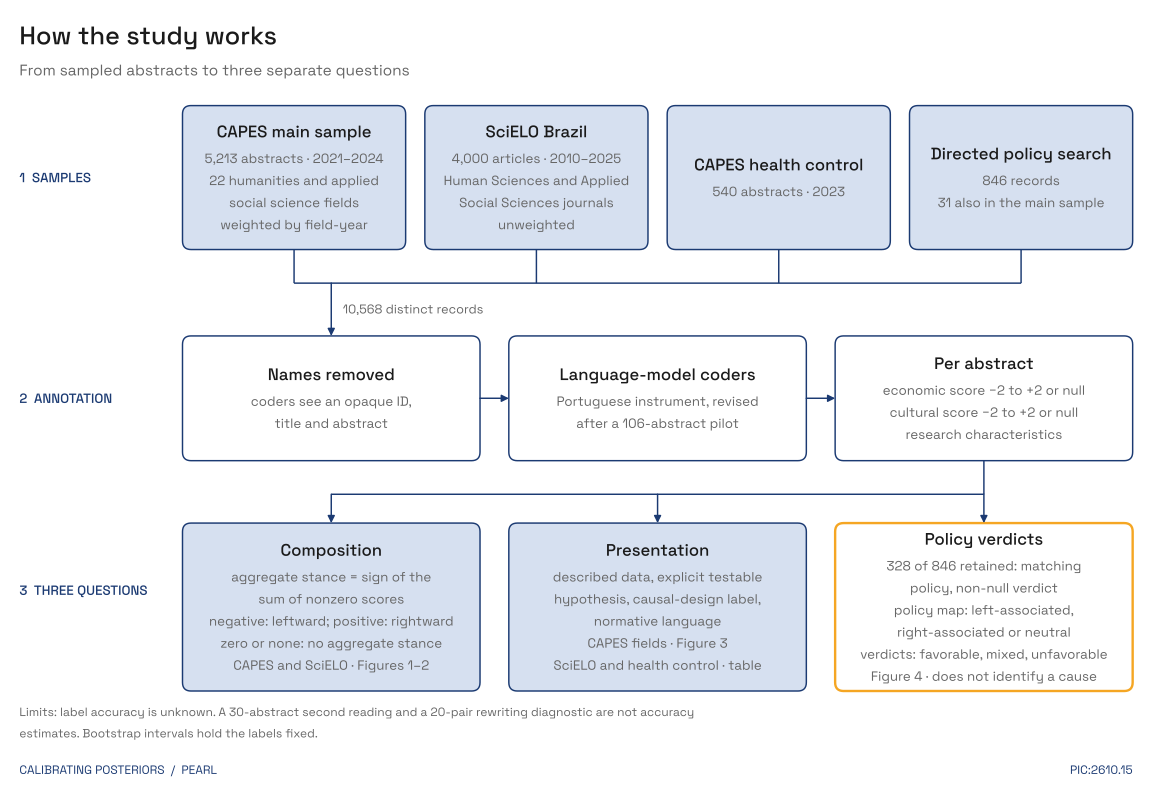
The main CAPES sample contains 5,213 abstracts in 22 humanities and applied social science fields from years 2021–2024. Collection used the official annual files, with a minimum abstract length of 400 characters. Seeded reservoir sampling selected up to 60 works per field and year. Twenty fields contribute 240 abstracts each; Archaeology contributes 218 and Demography 195. The annual counts are 1,289, 1,305, 1,307 and 1,312. The eligible field-year populations total 112,547 works. Percentages for this sample use each field-year's eligible population divided by its sample size as the weight.
The CAPES sample includes 3,113 academic master's dissertations, 1,317 academic doctoral theses, 772 professional master's dissertations and 11 professional doctoral theses. These are graduate research outputs, not a sample restricted to published journal articles.
The 4,000 SciELO records are research articles from 2010–2025 in Brazil-collection journals tagged Human Sciences or Applied Social Sciences. We shuffled the article-identifier pool using a fixed seed, retrieved metadata and retained records with Portuguese abstracts of at least 400 characters. SciELO proportions are unweighted. Collection membership does not require that every author be Brazilian, and the journal/topic composition may vary across periods.
Two supplementary samples extend the comparisons. A CAPES health-science sample contains 540 abstracts from 2023. A policy search contains 846 unique records selected through aliases in a closed policy map; 31 also occur in the main CAPES sample. The source corpus therefore contains 10,568 distinct records: 5,213 + 4,000 + 540 + 846 − 31. A separate diagnostic set adds 20 copies of originals and 20 rewritten counterparts; these 40 validation records do not increase the substantive sample sizes.
Student and supervisor names were discarded during collection. Coders received opaque identifiers, titles and abstracts, without author, institution or journal metadata as classification inputs. Texts could still contain contextual clues. The analysis retains one structurally complete classification per expected record identifier, resolves parent/sub-batch overlap deterministically and prevents incomplete records from silently entering the aggregate denominator.
Annotation and estimation
The Portuguese coding instrument assigns separate economic and cultural scores from −2 to +2, or null when an axis is not evaluated. Negative economic scores indicate criticism of capitalism, market allocation, privatization or austerity, or support for redistribution and state provision. Positive scores indicate support for markets, competition, fiscal adjustment or deregulation, or criticism of state intervention. Negative cultural scores indicate progressive positions; positive scores indicate conservative positions. The full operational definitions are in the methods supplement.
The instruction distinguishes a topic from an evaluation: studying inequality, religion or gender does not itself count as taking a side. It directs the coder toward neutral options when uncertain, requests a literal supporting excerpt of up to 30 words, and excludes broadly consensual positions such as opposition to Nazism or torture. Political subject matter is coded separately and requires a central contemporary dispute; an incidental evaluative statement can receive a stance label without making the topic centrally political.
The coding instrument was revised after a 106-abstract Haiku pilot. Subscription-based language-model subagents then annotated the larger corpus, with GPT-6 Luna used during continuation and recovery. Because model provenance is not complete at the individual-record level, we treat the corpus as one annotation exercise and do not estimate model-specific effects.
The aggregate stance is the sign of the sum of nonzero economic and cultural scores. A negative sum is classified leftward and a positive sum rightward. No nonzero scores or an exact cancellation yield no aggregate stance. Five source records contain opposing scores that cancel. Consequently, no aggregate stance does not mean that the author is neutral or that every axis is unpositioned.
Research characteristics include normative language, research type, a specific question or objective, an explicit testable hypothesis, described data, inference design and conclusion type. The empirical-type aggregate contains quantitative, qualitative and mixed empirical categories. Documentary/historical research, case studies and systematic reviews remain separate categories even when they use evidence. Data description requires an identifiable source and sample size or corpus scope. The causal-design label follows stated strategies, including experiments, quasi-experiments, matching and fixed-effects panels; it is not an audit of whether their causal assumptions hold.
For the main CAPES sample, we use weighted proportions and 1,000 within-field-year bootstrap resamples. The resulting 95% intervals reflect sampling uncertainty conditional on fixed classifications. They exclude annotation error and uncertainty about the ideological construct. Supplementary health and directed-policy comparisons are unweighted and descriptive.
Distribution of assigned ideological stance
| Indicator | CAPES, weighted; n = 5,213 | SciELO, unweighted; n = 4,000 |
|---|---|---|
| Central political subject matter | 31.3% | 34.7% |
| Assigned an aggregate stance | 25.9% | 23.6% |
| Leftward, among all abstracts | 23.5% | 22.9% |
| Rightward, among all abstracts | 2.4% | 0.8% |
| No aggregate stance | 74.1% | 76.4% |
| Leftward, among stance-assigned abstracts | 90.7% | 96.8% |
| Explicit normative language | 26.4% | 13.1% |
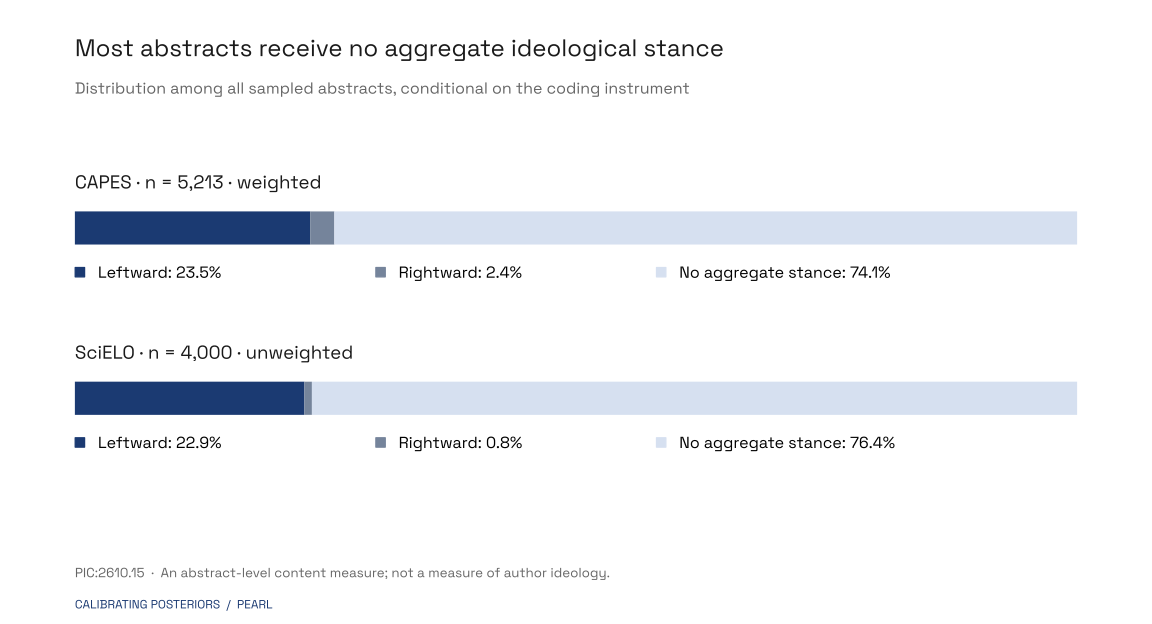
In SciELO, the underlying counts are 916 leftward, 30 rightward and 3,054 without an aggregate stance. The conditional leftward share is 916/946 = 96.8%. In CAPES it is 90.7% using the survey weights; the unweighted count of stance-assigned records is 1,280. Ratios are computed before rounding the component percentages.
The CAPES bootstrap interval is 24.1–27.7% for assigned stance, 21.8–25.0% for leftward stance among all abstracts, and 1.8–3.1% for rightward stance. These intervals describe precision within the measurement system, not the reliability of the labels themselves.
The asymmetry is present on both axes. In weighted CAPES estimates, economic scores are negative in 11.2% and positive in 2.2% of abstracts. Cultural scores are negative in 15.2% and positive in 0.23%. These axis-specific rates can overlap within a record and should not be summed to recover the aggregate distribution.
Differences across disciplines
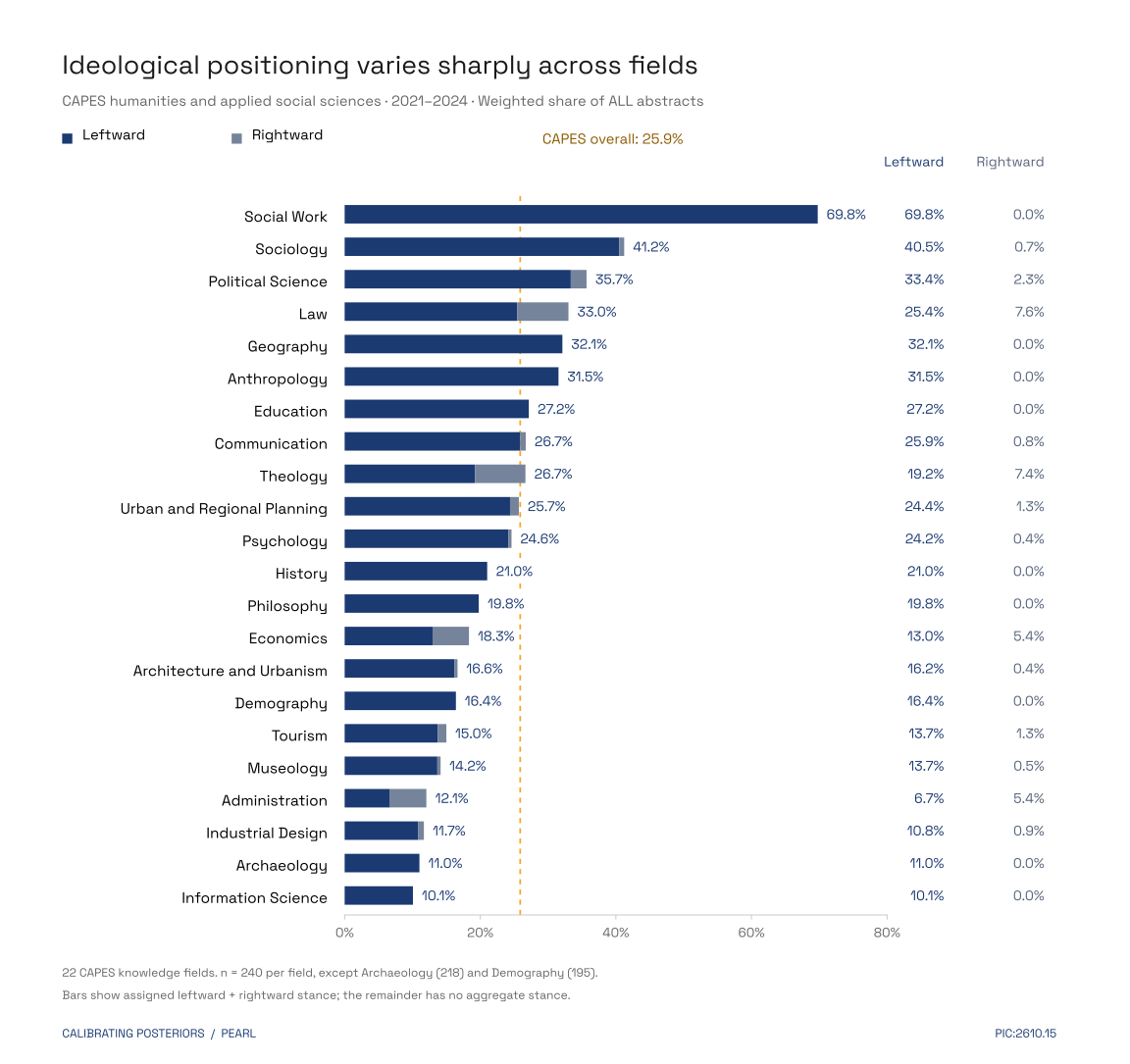
Percentages refer to all abstracts within each field and use field-year weights. Figure 2 shows all 22 fields. On mobile, scroll within the chart or open the full-size SVG. Social Work has the highest rate of assigned stance. Administration is comparatively balanced between directions. Demography illustrates why stance frequency and directional balance are separate: its relatively low positioning rate coexists with exclusively leftward aggregate labels among those positioned. A zero is a sample result under the classifier, not evidence that a field has no conservative researchers.
Theoretical reference labels are also heterogeneous. Marxist/critical theory is identified in 5.7% of weighted CAPES abstracts, Foucault/post-structuralism in 4.1%, feminism/intersectionality in 3.4%, decolonial/postcolonial approaches in 3.1% and liberal/neoclassical/rational-choice approaches in 2.2%. No framework is identified in 48.5%. These abstract-level categories neither identify personal political allegiance nor justify describing most output as Marxist.
Data, hypotheses and normative presentation
| Research characteristic | CAPES humanities/applied social sciences | SciELO | CAPES health sciences |
|---|---|---|---|
| Empirical research category | 60.5% | 53.5% | 88.5% |
| Data described | 62.8% | 56.6% | 87.8% |
| Explicit testable hypothesis | 10.5% | 7.4% | 10.0% |
| Causal-design label | 1.8% | 1.4% | 18.5% |
| Conclusion coded as an empirical finding | 43.3% | 42.3% | 87.2% |
| Evaluative conclusion assumed as a premise | 5.2% | 1.5% | 0.9% |
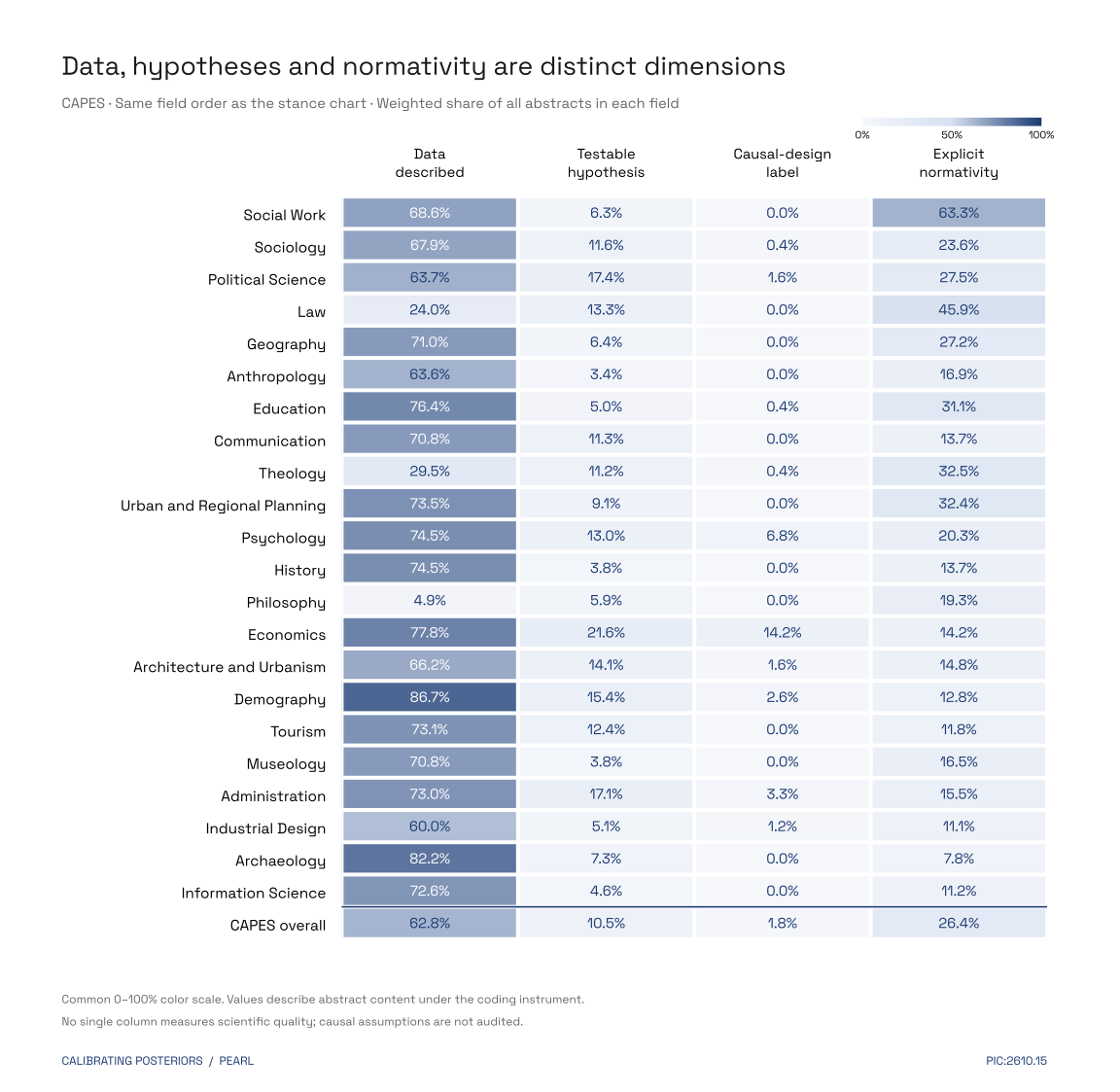
The majorities describing data are incompatible with a blanket description of these corpora as research without evidence. The narrower empirical-type category must be interpreted through its taxonomy. In History, for example, only 21.6% enter that aggregate, while 74.5% describe data. Documentary research explains why the two measures can diverge.
Economics within CAPES has 83.5% empirical-type labels, 77.8% data description, 21.6% explicit hypotheses and 14.2% causal-design labels. Relative to Economics and the health control, the main sample has lower rates of data description and causal-design labels. Explicit testable hypotheses, however, occur at approximately the same frequency in the main CAPES sample and health control: 10.5% versus 10.0%. Low abstract-level hypothesis frequency therefore does not, by itself, distinguish humanities from health sciences.
Among the 1,476 CAPES abstracts assigned central political subject matter, the 983 empirical-type records have a weighted positioning rate of 60.8%, compared with 62.8% for the other 493 records. Explicit normative language is 48.4% versus 53.1%, and evaluative premises 13.0% versus 14.0%. These small pooled differences coexist with larger variation by research type: explicit normative language appears in 22.2% of quantitative empirical abstracts, 53.3% of qualitative empirical abstracts, 56.0% of theoretical/conceptual abstracts, 78.1% of narrative reviews and 89.9% of critical normative essays. The last category partly incorporates normativity by definition.
These observations do not support a simple account in which ideological positioning occurs predominantly where data are absent. They also do not measure scientific quality. A sound descriptive, archival or philosophical contribution need not contain a causal design or an explicit hypothesis in its abstract.
Directed policy evaluations
The policy analysis retains 328 of the 846 directed-search records: the evaluated policy must match the search policy's aliases and have a non-null verdict. A pre-existing project map assigns policies to left-associated, right-associated or neutral categories. These categories are analytical choices. The table describes different policy sets rather than matched evaluations of identical evidence.
| Policy category | n | Favorable | Mixed | Unfavorable |
|---|---|---|---|---|
| Left-associated | 118 | 30.5% | 43.2% | 26.3% |
| Right-associated | 202 | 12.4% | 14.9% | 72.8% |
| Neutral | 8 | 12.5% | 25.0% | 62.5% |
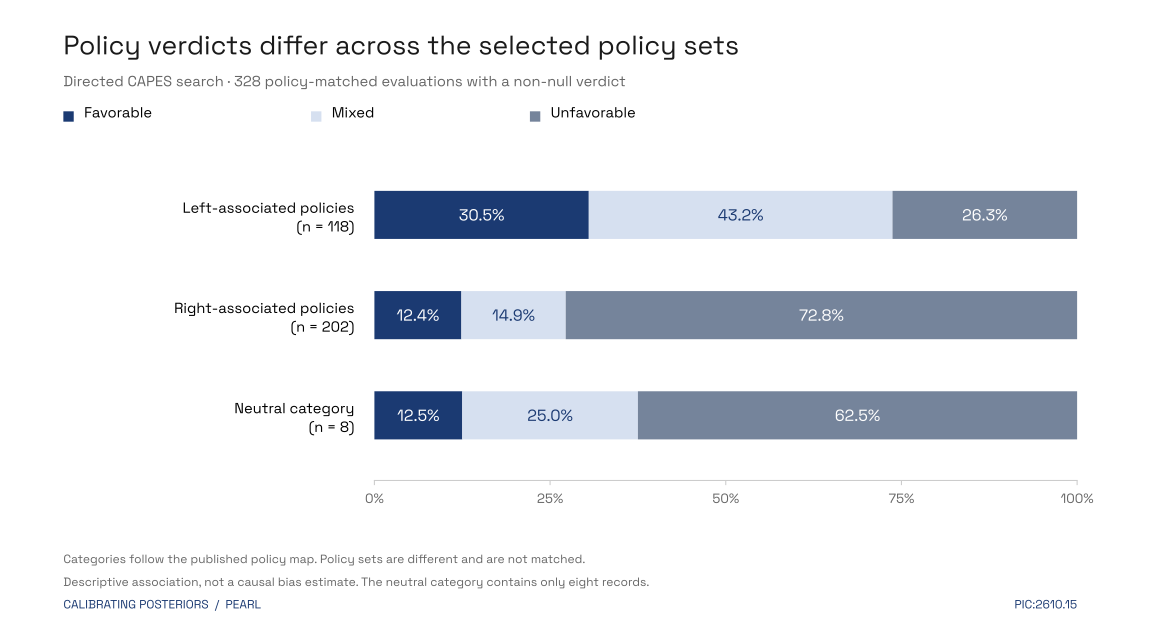
The classification also records why a policy is criticized. Among mixed/unfavorable evaluations of left-associated policies, 41.5% describe insufficient scope and 14.6% excessive intervention; for right-associated policies the corresponding shares are 10.7% and 72.9%. Other responses concern implementation or have no coded direction. Thus a negative verdict can express a demand for more of a policy rather than rejection of its underlying objective.
The individual-policy counts show both concentration and exceptions. The 2017 labor reform receives 25 unfavorable verdicts among 27 evaluations; the spending cap 22 among 25; the secondary-school reform 23 among 26. The Economic Freedom Law receives eight favorable evaluations among 14, and the sanitation framework eight among 17. Bolsa Família receives 11 favorable and three unfavorable evaluations among 24, while Minha Casa Minha Vida receives one favorable and nine unfavorable evaluations among 18.
The aggregate difference is a substantial descriptive association within this selected sample. It cannot distinguish ideological evaluation from differences in policy performance, research questions, disciplines or study design. It does not establish differential treatment of comparable evidence.
Temporal patterns and interpretation
In the SciELO sample, central political subject matter rises from 26.3% in 2010–2014 to 34.1% in 2015–2019 and 39.6% in 2020–2025. Assigned stance rises from 17.4% to 22.1% and 28.2%. Leftward labels rise from 16.5% to 21.4% and 27.5%, while rightward labels remain at approximately 0.7–0.8%. These are changes across sampled publication periods, potentially influenced by journal and topic composition.
CAPES positioning rates in 2021–2024 are 23.5%, 25.0%, 28.5% and 26.1%, respectively. This shorter series is not monotonic and is not directly comparable with the longer SciELO periods.
The main interpretive boundary is measurement. The coding rules operationalize substantive evaluations as ideological signals; agreement with an empirical finding is not thereby evidence of motivated reasoning. Model-assigned categories also have unknown misclassification rates in this domain. A qualitative second reading of 30 short, stance-assigned abstracts and a 20-pair rewriting diagnostic examined the instrument's behavior. The rewriting diagnostic is inconclusive because reversing a policy verdict can preserve the same ideological criterion. Neither exercise supplies a representative accuracy estimate. Bootstrap intervals cannot absorb this uncertainty.
The strongest conclusion concerns the observed output of a specified coding instrument: a minority of abstracts receives an aggregate ideological stance, leftward labels overwhelmingly dominate that minority, and the frequency and balance vary across disciplines. A majority describes data, while explicit hypotheses and causal-design labels are less common. These features can coexist within the same research corpus.
Conclusion and materials
This exploratory analysis documents a pronounced directional asymmetry in the labels assigned to Brazilian academic abstracts. It also documents substantial disciplinary variation and frequent data description, avoiding the inference that ideological presentation necessarily substitutes for empirical work. The policy sample adds evidence of differing evaluative distributions across politically categorized policy sets, without identifying their cause.
The result is evidence about research presentation under the stated measurement rules. It is not an estimate of researchers' personal ideology or a demonstration that political commitments distorted scientific conclusions. The descriptive asymmetry warrants examination with independent content measures, and its magnitude should remain conditional on the instrument until such measures establish label validity.
The public methods and aggregate-results supplement contains the Portuguese instrument, policy map, collection and analysis code, complete aggregate tables and machine-readable field results. Record-level abstracts and annotations are not redistributed with this edition. Official source releases are linked below. English and Portuguese editions share identifier PIC:2610.15 and report the same analysis. This is an exploratory PEARL working paper, not a confirmed-internal result or a peer-reviewed article.
References
- CAPES. [2021 a 2024] Catálogo de Teses e Dissertações — Brasil. Official open-data catalogue, annual releases used for the 2021–2024 sampling frame. Dataset and resource metadata. Retrieved for this study in October 2026.
- SciELO. Scientific Electronic Library Online, Brazil collection; ArticleMeta metadata service. Collection · ArticleMeta API. Source for journal subject areas, article identifiers and abstracts.
- Grimmer, J., & Stewart, B. M. (2013). Text as Data: The Promise and Pitfalls of Automatic Content Analysis Methods for Political Texts. Political Analysis, 21(3), 267–297. doi:10.1093/pan/mps028.
- Gilardi, F., Alizadeh, M., & Kubli, M. (2023). ChatGPT outperforms crowd workers for text-annotation tasks. Proceedings of the National Academy of Sciences, 120(30), e2305016120. doi:10.1073/pnas.2305016120.