Independent build · AI evaluation
Can an AI build a good game in one pass?
Game Bench gives coding models the same game brief, a clean workspace, and no feedback. Every result stays playable, so you can inspect the code and decide whether the score matches the experience.
Live benchmark · updated as new runs are scored
The problem
Most model demos hide the conditions that produced them.
A polished clip tells you little when one model had a detailed prompt, another had three rounds of feedback, and a third inherited working code. I wanted an artifact test with visible constraints.
Browser games force a model to combine interaction, state, rendering, onboarding, tuning, failure states, and polish. You can tell within a minute whether the result works.
The protocol
Same assignment. Same stopping rule.
Reproducible runs · public artifacts · cost-aware comparison
-
01
Freeze the brief
Each model receives the same mechanics, platform, art, audio, and quality constraints.
-
02
Let it build
The model starts in an empty workspace. I provide no corrections, examples, or follow-up prompts.
-
03
Score the artifact
I test gameplay, prompt adherence, engineering, and art, then publish the game, rubric, cost, and score.
What I learned
A benchmark needs an opinion about useful work.
Passing tests does not make a game fun. Visual polish cannot rescue unclear controls. A cheap run can be the better product choice even when it loses on raw score.
- The leaderboard can sort each scoring pillar, not only the final index.
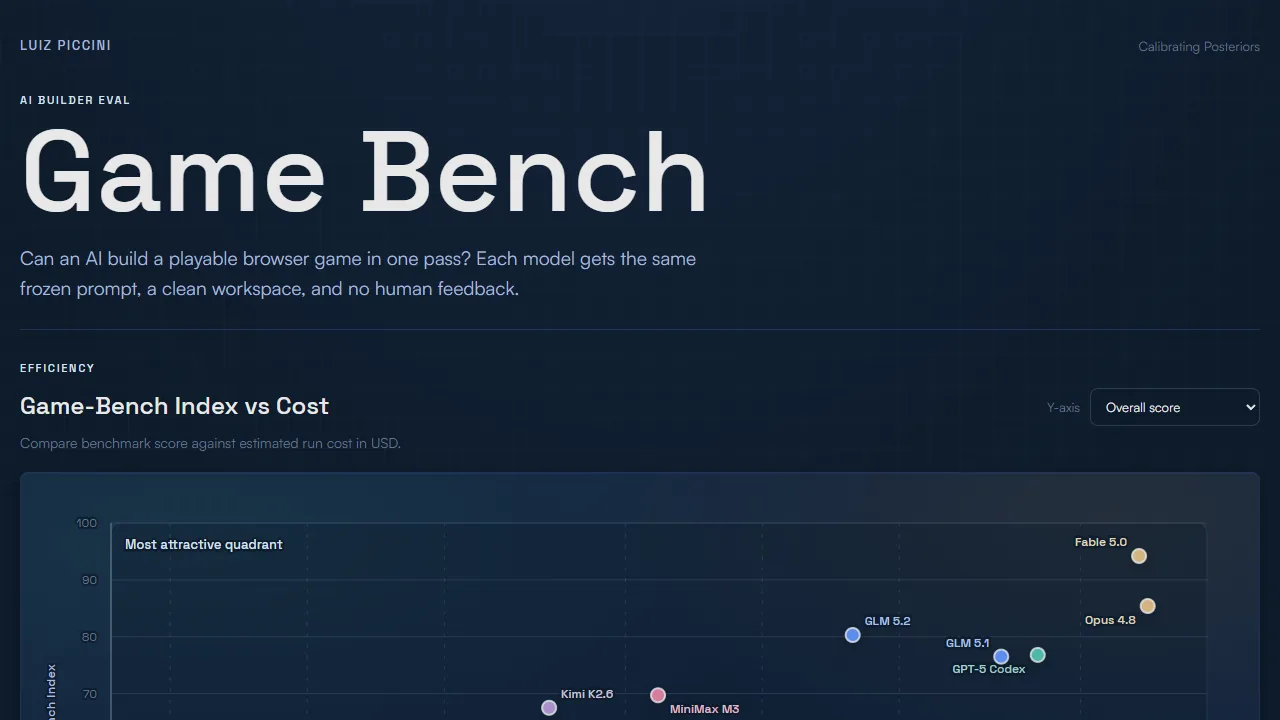
- The efficiency chart separates raw quality from the cost required to produce it.
- Blind routes let players judge the game before seeing the model name.
Why I run this
I’m Head of Product at Tela, where we help large companies put AI to work in their core operations. This means interacting and testing with many models and understanding which is the best at what job.
Game Bench is my personal project to test models in public in a fun way that is dear to me: what are the best models for making games?
Explore Tela ↗Judge the outputs
Play first. Reveal the model later.
Nine anonymous builds are available in the blind-test flow.